Showing posts with label visa. Show all posts

28 July 2026

South Africa's proposed R500 ETA fee explained: What international travellers need to know

Traveller Update (19 August 2026): The proposed R500 ETA processing fee is no longer just a proposal — it is now officially in force. The Department of Home Affairs gazetted the amended immigration fee regulations on 17 August 2026, and the fee took effect on that date.

In practice, this means:

  • Travellers from non-visa-exempt countries who are not fee-exempt now pay the R500 ETA processing fee plus the existing R425 visa fee, bringing the total to R925 — down from R1,975 under the old outsourced-processing system.
  • Travellers from visa-required, visa-fee-exempt countries pay only the R500 processing fee.
  • Travellers from visa-exempt countries (including Germany, the UK, the US and others listed above) are not required to use the ETA and can continue entering under existing visa-free arrangements. Should they choose to use the ETA voluntarily for a smoother arrival, the R500 fee applies to them too.

The fee's introduction follows the ETA's official launch by President Cyril Ramaphosa at OR Tambo International Airport on 12 August 2026. At this stage, the mandatory use of the ETA still applies only to selected visa-required travellers from China, India, Indonesia and Mexico, with further country expansions expected but not yet confirmed.

Bottom line for most readers of this blog:
if you're travelling from a visa-exempt country, nothing changes for your entry requirements — the R500 fee is now real, but it isn't compulsory for you. We'll keep updating this page as the ETA rollout expands to more nationalities. 

Traveller Update (13 August 2026): South Africa has officially launched its Electronic Travel Authorisation (ETA) system, with President Cyril Ramaphosa formally launching the system at OR Tambo International Airport on 12 August 2026.

In his launch speech, Ramaphosa confirmed that the ETA is being positioned as a long-term part of South Africa's digital immigration system. The system was initially introduced for travellers from China, India, Indonesia and Mexico, and the President said that government is now preparing to expand the ETA to additional countries. He did not announce which countries will be added or give a timetable for the expansion.

Importantly for travellers watching the proposed R500 ETA fee, Ramaphosa did not mention the fee in his speech. There was no announcement confirming the proposed R500 charge, changing its amount or stating when it would come into effect. The R500 processing fee therefore remains a proposal under the draft immigration regulations and should not yet be treated as a confirmed travel cost.

The President instead focused on the wider purpose of the ETA, saying it should make travel to South Africa easier, faster and more predictable while allowing authorities to conduct stronger pre-arrival screening, biometric verification and risk assessment. He also said that digital processing will eventually extend beyond visitor authorisations to work visas, study visas and other immigration services.

For international travellers, the key message is therefore that the ETA is now officially operational and is expected to expand, but the proposed R500 fee has not been confirmed by the President and is not yet in force. 

Traveller Update (28 July 2026): South Africa has proposed introducing a R500 processing fee for its Electronic Travel Authorisation (ETA) system as part of draft immigration regulations. The proposal is currently open for public comment and has not yet come into effect. The ETA is currently mandatory only for selected visa-required travellers from China, India, Indonesia and Mexico, with a broader rollout expected over time. This article will be updated as soon as the final regulations are published.
South Africa is continuing its move towards a modern, digital immigration system, and one of the latest proposals could introduce a R500 processing fee for travellers using the country's Electronic Travel Authorisation (ETA).

If you're planning a safari in the Kruger National Park, a road trip along the Garden Route, a wine tour in the Cape Winelands or a beach holiday in KwaZulu-Natal, you may be wondering whether this new fee will affect your trip.

The short answer is not necessarily.

Here's what travellers should know about the proposal, who could be affected, and why South Africa is introducing the new system.


What is South Africa's ETA?

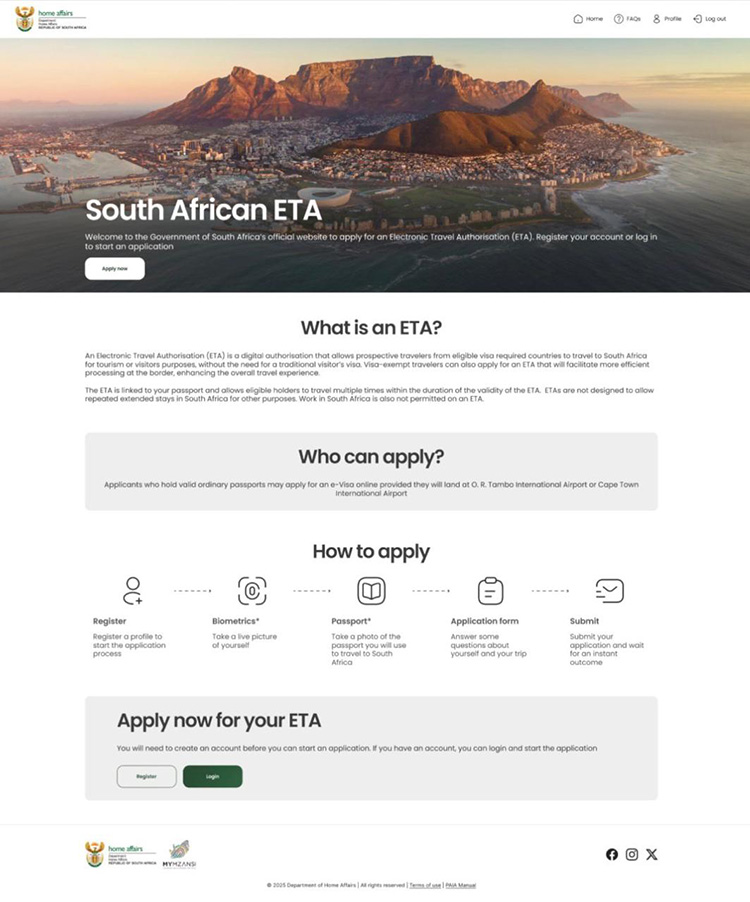
The Electronic Travel Authorisation (ETA) is a new online system that allows eligible travellers to obtain travel authorisation digitally before departing for South Africa.
The initiative forms part of the Department of Home Affairs' wider plan to modernise immigration services, reduce paperwork and replace much of the current manual visa process with a faster, more secure and more efficient digital system.
It is important to understand that an ETA is not the same as a visa. Instead, it is an electronic travel authorisation issued before departure. As with any international journey, the final decision to admit a traveller always rests with immigration officials at the port of entry.
The ETA system is being introduced in phases. At present, it is only mandatory for selected visa-required travellers from China, India, Indonesia and Mexico. The Department of Home Affairs intends to expand the platform gradually to additional visa-required nationalities, while travellers from visa-exempt countries continue to enter South Africa under the existing visa-free arrangements.


Why is a R500 processing fee being proposed? 


Under draft immigration regulations published by the Department of Home Affairs, travellers using the ETA system would pay a R500 processing fee.
According to the department, the fee would help fund the operation and maintenance of the digital platform, replace the current ETA fee waiver and reduce reliance on outsourced visa processing centres. For many travellers who currently require a visa, the new system could ultimately reduce the overall cost of obtaining permission to travel to South Africa.
At this stage, however, the fee remains a proposal. The regulations are still subject to public consultation before any implementation date can be announced.
 

Will the proposed ETA fee affect your trip?

 
Whether the proposed fee applies depends on your nationality and your current entry requirements.

Travellers from visa-exempt countries

If you hold a passport from a country that already enjoys visa-free access to South Africa for short tourist visits, your existing visa exemption remains unchanged.
Examples include travellers from:
  • Germany
  • United Kingdom
  • Ireland
  • France
  • Netherlands
  • Belgium
  • Switzerland
  • United States
  • Canada
  • Australia
  • New Zealand
Under the current proposal, these travellers would continue to enter South Africa under existing visa-free arrangements.
Should visa-exempt travellers choose to use the ETA system in the future—if it remains available to them on a voluntary basis—they would pay the proposed R500 processing fee.

Travellers from China, India, Indonesia and Mexico

The ETA is currently mandatory for selected visa-required travellers from China, India, Indonesia and Mexico. These travellers already use the electronic system instead of the traditional visa application process.
If the draft regulations are approved, applicants using the ETA platform would pay the proposed R500 processing fee.

Travellers from other visa-required countries

Visitors from countries that currently require a visa, but are not yet covered by the ETA rollout, are expected to transition to the digital platform as it expands.
For these travellers, the ETA aims to simplify the application process by allowing applications to be completed online instead of visiting visa application centres.
Some travellers who currently benefit from visa-fee exemptions could pay only the ETA processing fee, while others may pay both the applicable visa fee and the ETA processing fee, depending on the final regulations.
The Department of Home Affairs has indicated that the digital process should reduce the overall cost for many visa applicants compared with the existing outsourced application system.
 

Why is South Africa introducing an ETA?

 
South Africa is following a growing international trend towards digital border management.
Countries around the world have introduced similar electronic travel authorisation systems to improve border security, speed up immigration procedures and make travel more convenient.
By moving applications online, South Africa hopes to:
  • reduce processing times
  • improve security screening before arrival
  • modernise immigration services
  • reduce paperwork
  • reduce reliance on outsourced visa processing centres
  • make travel planning easier for legitimate visitors.
For most holidaymakers, the biggest advantage should be a more efficient application process once the system is fully operational.
 

What travellers should do now

 
If you're planning a trip to South Africa over the coming months, there's no need to change your travel plans based on the proposal alone. Unless you are travelling from one of the countries currently included in the ETA rollout—China, India, Indonesia or Mexico—the new system is unlikely to affect your immediate travel arrangements.
Before you travel:
  • Check whether your nationality requires a visa.
  • Confirm whether your country is currently part of the ETA rollout.
  • Monitor official announcements regarding the proposed R500 processing fee.
  • Use only official South African government channels when applying for visas or an ETA.
  • Apply well in advance of your departure date.
As with any change to immigration rules, requirements can evolve before the final regulations are published.
 

Frequently Asked Questions

 
Is the R500 ETA fee already in force?
No. The R500 processing fee has been proposed as part of draft regulations and is not yet in effect.
Yes, as of 17 August 2026

Which travellers currently need an ETA?
At present, the ETA is mandatory only for selected visa-required travellers from China, India, Indonesia and Mexico. The system is expected to expand gradually to additional visa-required nationalities.

Will visa-free travellers still be able to visit South Africa?

Yes. The proposal does not remove existing visa exemptions. Travellers from visa-exempt countries can continue to visit South Africa under the current entry rules.

Do German travellers need an ETA?
No. German passport holders remain eligible for visa-free tourist visits.

Do British travellers need an ETA?
No. UK passport holders also continue to enjoy visa-free entry for eligible short stays.
Do US travellers need an ETA?
No. US passport holders also continue to enjoy visa-free entry for eligible short stays.

Is an ETA the same as a visa?
No. An ETA is an electronic travel authorisation that forms part of South Africa's new digital immigration system. It is not a traditional visa, and immigration officials at the port of entry retain the final authority to grant or refuse entry.

When will the proposed R500 fee take effect?

There is currently no confirmed implementation date. The proposal must first complete South Africa's regulatory process before the fee can be introduced. Comments and submissions on the proposed fee structure can be made to the Department of Home Affairs before 11 August 2026.


Bottom line

South Africa's proposed R500 ETA processing fee is part of a broader effort to modernise the country's immigration system rather than introduce a new tourism tax.

For most travellers from visa-exempt countries, nothing changes for now. Those who already enjoy visa-free access can continue travelling under the existing rules while the ETA system is gradually expanded.

At present, only selected visa-required travellers from China, India, Indonesia and Mexico are required to use the ETA. If approved, the proposed R500 processing fee would apply to applications submitted through the electronic system.

As South Africa continues rolling out its digital immigration platform, travellers should always check the latest official entry requirements before departure. We'll continue monitoring developments and update this guide as soon as the final regulations—and any implementation dates—are announced. 
 
Subscribe for updates:

Subscribe to our newsletter for weekly updates, border info, road alerts, and travel inspiration for Southern Africa. 

19 March 2026

South Africa ETA 2026: Latest updates, who needs it & what travellers must know

Last update: 28 July 2028

new blogpost: South Africa's proposed R500 ETA fee explained: What international travellers need to know 

Last update: 23 July 2026

South Africa’s Electronic Travel Authorisation (ETA) system continues to evolve, although there have been no changes to the current traveller eligibility since our previous update. The system remains mandatory for selected visa-required travellers from China, India, Indonesia and Mexico, while visitors from visa-exempt countries—including Germany, the EU, the UK and the USA—continue to travel under the existing entry rules.

The most significant development since the last update is the Department of Home Affairs' confirmation that the ETA platform will also underpin additional digital immigration services. As part of the newly launched Phase II of the Trusted Employer Scheme (TES), the online application process will ultimately be integrated into the ETA platform, reinforcing its role as South Africa’s central digital immigration system rather than simply an online tourist visa tool.

While no additional traveller nationalities or ports of entry have yet been announced for the ETA, these latest developments demonstrate that the government continues to invest in the platform as the long-term foundation of a fully digital, biometric-based immigration system. For travellers, the practical entry requirements remain unchanged for now, but the ETA is steadily becoming an increasingly important part of South Africa’s broader border modernisation programme

Last updated: 28 May 2026

South Africa’s Electronic Travel Authorisation (ETA) system continues to advance steadily, with the clearest recent development being the government’s intensified focus on integrating the ETA into a broader nationwide digital identity and border modernisation programme. Since mid-May 2026, the Department of Home Affairs has accelerated rollout plans for biometric verification systems and digital traveller processing infrastructure, reinforcing the ETA’s role as the future backbone of South Africa’s visa and border management system.

Recent official communications have also placed stronger emphasis on expanding digital processing capacity ahead of wider ETA implementation at additional airports and selected land border posts. While the ETA itself remains limited to selected visa-required nationalities such as travellers from China, India, Indonesia and Mexico, authorities are increasingly positioning the platform as a long-term replacement for traditional visitor visa processing rather than a standalone pilot project.

For most international visitors, including travellers from Germany, the EU, the UK and the USA, entry requirements remain unchanged and no ETA is currently required. However, the pace of digital infrastructure development suggests that South Africa is moving more decisively toward a fully biometric, digitally managed travel system, with further ETA expansion likely during the second half of 2026. 

Last updated: 15 May 2026

South Africa’s Electronic Travel Authorisation (ETA) system continues to move beyond its original pilot phase, with several important developments emerging. Most notably, government officials and tourism authorities are now publicly presenting the ETA as the future foundation of South Africa’s entire visitor visa system, rather than simply a limited travel pilot. During Africa’s Travel Indaba 2026 in Durban, Tourism Minister Patricia de Lille again highlighted the ETA as a key tool to simplify travel and boost tourism growth.

At the same time, South Africa’s broader digital immigration infrastructure is accelerating rapidly. New biometric and digital identity systems are being rolled out nationwide, while Home Affairs continues expanding digital services and facial-recognition verification technology across airports, border systems and banking platforms. These developments strongly reinforce expectations that the ETA will steadily expand to additional nationalities and ports of entry during the remainder of 2026.

Despite this momentum, practical travel requirements remain largely unchanged for now. The ETA is still primarily limited to selected visa-required nationalities such as travellers from China, India, Indonesia and Mexico, while visa-free visitors from Germany, the EU, the UK and the USA continue to enter South Africa without needing ETA approval. However, the overall direction is now unmistakable: South Africa is rapidly building a fully digital, biometric-based border and visa system, with the ETA positioned at its centre. 

Last updated: 06 May 2026

South Africa’s Electronic Travel Authorisation (ETA) continues to expand in phased rollout, with recent government updates confirming it will become the country’s central digital visa platform in the coming years. While the ETA remains mandatory only for selected visa-required markets such as China, India, Indonesia and Mexico—and is still not required for travellers from Germany, the EU, the UK or the USA—the policy direction is now clear. Authorities are accelerating the rollout of biometric systems at airports and land borders, paving the way for wider implementation. For now, travel requirements remain unchanged for most visitors, but the ETA is steadily evolving into the default entry system for South Africa as expansion continues through 2026. 

Last updated: 16 April 2026 

South Africa’s Electronic Travel Authorisation (ETA), launched in September 2025, remains in a phased rollout and is still only partially implemented as of April 2026. It is currently mandatory for selected visa-required markets including China, India, Indonesia and Mexico, where approval must be obtained before travel, while no ETA is required for most other visitors such as travellers from Germany, the EU, the UK and the USA. Since the initial pilot at major airports like OR Tambo and Cape Town, the system has gradually expanded to additional entry points including Lanseria International Airport, with government policy now clearly indicating that the ETA will become South Africa’s central digital visa platform over time. Further expansion to more nationalities and selected border posts is expected during 2026, although the system remains transitional and not yet universally applied across all travellers or entry points.

Last updated: 19 March 2026

South Africa’s Electronic Travel Authorisation (ETA), first introduced in September 2025, marks a major shift in how travellers enter the country. Designed to replace traditional visa processes with a fast, digital alternative, the system allows visitors to apply online, upload documents and biometric data, and receive approval electronically - often within a short timeframe.

However, as of 2026, the ETA is not yet fully implemented worldwide. Instead, it is being rolled out in carefully managed phases.

The system was initially launched during a pilot phase in late 2025, focusing on G20 delegates from China, India, Indonesia, and Mexico arriving through major gateways such as OR Tambo International Airport (JNB) in Johannesburg and Cape Town International Airport (CPT) in Cape Town. This phase allowed authorities to test the platform, refine biometric verification processes, and ensure integration with South Africa’s broader border management systems.

Since then, the ETA has been expanded to include leisure travellers from these same four countries, with Lanseria International Airport (HLA), north of Randburg and Sandton, added as an additional entry point.. For travellers from these markets, the ETA is now a mandatory pre-travel requirement -meaning that without prior approval, boarding or entry into South Africa is not permitted.

For most European travellers, including those from Germany, as well as visitors from the UK and the United States, nothing has changed for now. Visa-free entry for short stays remains in place, and no ETA is currently required. That said, this is expected to evolve over time as the system expands.

From a traveller’s perspective, the ETA introduces a more streamlined and predictable process. Applications are completed online, approvals are linked directly to passports, and arrival procedures increasingly rely on biometric verification rather than manual checks. The long-term aim is to reduce queues, improve security, and remove administrative friction - particularly for visitors from high-growth tourism markets.

That said, the system is still maturing. Coverage remains limited, entry points are not yet universal, and there have been some early reports of technical teething issues. In practical terms, 2026 should be seen as a transition year, rather than a finished rollout.

Looking ahead, the direction is clear. South Africa is expected to expand the ETA to all visa-required nationalities, gradually replace traditional visitor visas, and extend the system to additional airports and land borders. There is also a strong possibility that, in the longer term, even visa-exempt travellers could be included - similar to systems being introduced in Europe and the UK.

For now, the key takeaway is simple: the ETA is live, but only for selected travellers. If you are visiting from Europe, you can continue to travel as usual. If you are travelling from one of the currently included countries, applying for an ETA in advance is essential.

South Africa’s ETA is ultimately about making travel easier - but for the moment, it remains a system in progress, and one that travellers should continue to monitor closely as it expands through 2026 and beyond.


Subscribe for updates:

Subscribe to our newsletter for weekly updates, border info, road alerts, and travel inspiration for Southern Africa. 

12 January 2026

Zambia introduced new visa fees: What travellers need to know!

last updated: 12 January 2026

According to  Zambia Tourism, the Zambian Department of Immigration has implemented revised visa fees, effective 01 January 2026 until further notice. The new fee structure primarily affects travellers from visa-requiring countries, with single-entry and double-entry visa costs doubling compared to previous rates.
The adjustment is part of Zambia’s ongoing immigration and border management framework and applies across standard tourist visa categories.

Overview of Zambia’s updated visa fees (effective 01 January 2026)

Single-Entry Visa

  • New fee: USD 50 (previously USD 25)
  • Validity: Up to 90 days
  • Description: Allows the holder to enter Zambia once during the visa’s validity period.

Double-Entry Visa

  • New fee: USD 80 (previously USD 40)
  • Validity: Up to 90 days
  • Description: Permits two separate entries into Zambia within the validity period.

Multiple-Entry Visa

  • New fee: USD 80 (previously USD 75)
  • Validity: Up to 90 days
  • Description: Allows multiple entries into Zambia during the visa’s validity.
  • Important note: Multiple-entry visas are only issued by Immigration Headquarters and must be applied for via the official e-visa platform.

Visa categories with unchanged fees

KAZA Univisa

  • Fee: USD 50 (unchanged)
  • Validity: Up to 30 days

The KAZA Univisa allows tourists to travel freely between Zambia and Zimbabwe on a single visa. It also covers day trips to Botswana via the Kazungula Border, provided travellers re-enter Zambia or Zimbabwe.
The KAZA Univisa is not available online and can currently only be obtained at the following ports of entry:

  • Kenneth Kaunda International Airport (LUN) – Lusaka
  • Harry Mwanga Nkumbula International Airport (LVI) – Livingstone
  • Victoria Falls International Airport (VFA) – Zimbabwe
  • Robert Gabriel Mugabe International Airport (HRE) – Harare
  • Victoria Falls Border Post
  • Kazungula Border Post

Day-Tripper Visa

  • Fee: USD 10 (unchanged)
  • Validity: Less than 24 hours

A Day-Tripper Visa is issued at select ports of entry to tourists visiting Zambia for less than 24 hours, provided they exit through the same border post. It also applies to travellers briefly entering a neighbouring country and returning to Zambia within 24 hours.
Currently available only at:

  • Victoria Falls Border
  • Kazungula Border Control

Visa validity rules

  • Single-entry, double-entry and multiple-entry visas are valid for 90 days from the date of first entry.
  • Exception: Nationals of the United States of America may receive multiple-entry visas valid for up to three years, based on a reciprocal agreement between Zambia and the USA.

Zambia’s liberal visa policy remains largely intact

Despite the increase in visa fees for certain travellers, Zambia continues to maintain one of Africa’s most liberal visa regimes. As of 2025, citizens of 167 countries are visa-exempt when travelling to Zambia.
For most international visitors, Zambia remains an accessible and traveller-friendly destination, particularly for those exploring the wider KAZA Transfrontier Conservation Area, including Victoria Falls, Chobe National Park, and Hwange National Park.

Travellers are advised to confirm visa requirements and applicable fees before departure, as immigration regulations may change without prior notice. 


Subscribe for updates:

Subscribe to our newsletter for weekly updates, border info, road alerts, and travel inspiration for Southern Africa. 
08 January 2026

Malawi introduces reciprocal eVisa policy: What travellers need to know!

Travellers planning a trip to Malawi in 2026 and beyond should be aware of an important change to the country’s visa and entry requirements. Malawi has officially implemented its reciprocal visa policy, supported by an electronic visa (eVisa) system, significantly altering who can enter the country visa-free.
The new policy affects many international travellers, particularly those from Europe, North America, and other long-haul markets that were previously granted visa-free access. The policy was officially gazetted by Minister of Homeland Security Peter Mukhito on 02 January 2026.

What is Malawi’s reciprocal visa policy?

Malawi’s reciprocal visa policy is based on a simple principle: countries that require visas for Malawian citizens will now face similar requirements when entering Malawi.
Visa-free entry has therefore been reduced to nationals of countries that offer Malawians visa-free or visa-on-arrival access. Travellers from non-reciprocal countries must now apply for a visa before travelling, primarily through Malawi’s official eVisa system.
This marks a clear reversal of the broad visa-free regime introduced in 2024.

Who needs a visa to visit Malawi now?

Under the new rules, many travellers who previously entered Malawi without a visa must now obtain an eVisa in advance. This includes travellers from major tourism source markets such as:

Countries that remain visa-free

Visa-free access remains in place for 22 non-regional countries, namely:

Regional and Institutional Exemptions
The following exemptions continue to apply under specific conditions:

  • SADC and COMESA: Nationals are exempt only where reciprocal visa-free arrangements exist. Exemptions do not apply if visas are required of Malawian citizens.
  • Laissez-Passer Holders: UN, AU, SADC, COMESA, and African Development Bank Laissez-Passer holders travelling on official business remain exempt.
  • Diplomatic and Service Passports: Exempt unless the holder’s home country requires visas from Malawian diplomatic or service passport holders.

Travellers should verify their exemption status carefully, as assumptions may lead to denied boarding.

Malawi eVisa: How the system works

Malawi now requires most affected travellers to apply through its official electronic visa platform prior to arrival.
Key points travellers should be aware of:

  • Visa-on-arrival is no longer guaranteed for affected nationalities
  • Airlines may refuse boarding without proof of an approved eVisa
  • Applications should be submitted well in advance of departure

Malawi Visa Types and Fees

The eVisa system offers several visa options depending on travel purpose and duration:

  • Transit Visa: USD 50
  • Single-Entry Tourist Visa: USD 50
  • Multiple-Entry Visa (6 months): USD 150
  • Multiple-Entry Visa (12 months): USD 250

Visa validity, permitted length of stay, and entry conditions are determined by immigration authorities at the time of approval.

Documents Travellers Should Prepare

When travelling to Malawi under the new visa regime, visitors should carry:

  • A passport valid for at least six months
  • A printed copy of the approved eVisa
  • Proof of accommodation
  • Proof of onward or return travel
  • Evidence of sufficient funds

Immigration checks may be stricter during the transition period as the new policy is enforced.

What This Means for Tourism in Malawi

Malawi remains committed to tourism growth, particularly in eco-tourism, wildlife experiences, cultural travel, and Lake Malawi holidays. While the new visa policy introduces an additional administrative step for some travellers, authorities have framed it as a matter of fairness and international parity, rather than restriction.

For travellers, the change primarily means planning ahead, rather than spontaneous travel.

Practical Advice for Travellers

If you are planning a trip to Malawi:

  • Check visa requirements as early as possible
  • Apply for an eVisa before booking flights
  • Allow additional processing time
  • Ensure all travel documents are complete

Tour operators and travel agents are also advised to update pre-departure information to reflect the new entry rules.

For most travellers, Malawi remains easily accessible - provided the new visa requirements are addressed before departure.


Subscribe for updates:

Subscribe to our newsletter for weekly updates, border info, road alerts, and travel inspiration for Southern Africa

19 December 2025

Mozambique pre-travel registration: What travellers should know!

Travellers planning a visit to Mozambique should be aware of the country’s pre-travel registration and Electronic Travel Authorisation (ETA) framework, which was formally introduced under Decree No. 10/2023.

While the regulation provides for mandatory online pre-travel registration for visa-exempt nationals, the requirement is currently not enforced. Mozambique’s immigration authorities suspended implementation in May 2025 after technical issues affected the online registration platform.

Current Position for Travellers
At present:

  • The ETA requirement remains in force in law
  • Online pre-travel registration is suspended
  • Visa-exempt travellers may enter Mozambique without completing an ETA
  • No official date has been announced for the reinstatement of the system.

Entry requirements still apply
Despite the suspension, travellers must still meet standard entry conditions, including:

Payment of any applicable entry fees on arrival, if requested

Key takeaway
Mozambique’s pre-travel registration system exists legally but is paused operationally. Travellers should check for official guidance shortly before departure, as the requirement may be reinstated at short notice.

We will continue to monitor and report on any changes affecting travel to Mozambique.


Subscribe for updates:

Subscribe to our newsletter for weekly updates, border info, road alerts, and travel inspiration for Southern Africa. 

28 November 2025

Malawi plans reciprocal visa policy: Major source markets could lose visa-free access!

Malawi’s Minister of Finance, Joseph Mwanmvekha, announced in the 2025–26 Mid-Year Budget Review Statement on 21 November 2025 that the country plans to revoke visa-free entry for most previously exempt nationalities. According to the announcement, “visa-free access to Malawi is being revoked with immediate effect and visa application fees will apply on a reciprocity basis.”

Under the proposed policy, travellers from countries that require Malawian nationals to obtain a visa will now need to apply for a Malawian visa prior to travel. Visa fees will also be aligned with what the traveller’s home country charges Malawian citizens. Only nationals of countries that offer Malawians visa-free entry will continue to access Malawi without a visa.

This change could have significant implications for tourism. Some of Malawi’s most important long-haul source markets -  including Germany, the United Kingdom, the United States, the Netherlands, France, Australia and Canada - may lose visa-free access if they do not offer Malawians the same privilege. Tourism stakeholders caution that stricter entry requirements, longer lead times for visa approvals and higher costs could dampen demand during peak travel periods. Tour operators may also need to adjust itineraries and booking processes, potentially affecting travel confidence and regional multi-country packages that include Malawi

However, according to Joseph Nkosi, Public Relations Officer at the Ministry of Tourism, the reciprocity proposal must still be tabled before Malawi's Parliament before it can take effect. [src]

Current Malawian visa fees range from US$50 for a seven-day transit visa to US$75 for a single-entry visa valid for up to 90 days.


Subscribe for updates:

Subscribe to our newsletter for weekly updates, border info, road alerts, and travel inspiration for Southern Africa

21 October 2025

Lithuania joins South Africa’s visa-free list: Lithuanian travellers can now visit visa-free for up to 90 days!

The Ministry of Foreign Affairs of the Republic of Lithuania has announced that, effective 07 October 2025, Lithuanian citizens can now travel to South Africa without a visa. Under the new policy introduced by South Africa’s Department of Home Affairs, Lithuanian passport holders may enter the country for stays of up to 90 days within a 180-day period, making it easier than ever to explore one of Africa’s most diverse travel destinations.

According to Audra Plepyt, Vice-Minister of Foreign Affairs of Lithuania, “this long-awaited decision opens up new opportunities to strengthen bilateral ties, promote tourism, cultural exchanges, academic cooperation, and business contacts between Lithuania and the Republic of South Africa.

The new visa exemption for Lithuanian travellers to South Africa is expected to boost visitor arrivals, encourage investment, and foster closer cooperation between the two nations. South Africa now joins the growing list of non-EU countries granting visa-free access to Lithuanian citizens.

However, the agreement is not reciprocal. South African passport holders are still required to apply for a Schengen visa when travelling to Lithuania or other countries in the Schengen Area.

While South Africa's Department of Home Affairs has not yet updated its official “Visa Exempt Countries” list to reflect the newest changes, a formal government circular dated 03 September 2025 confirms that Hungary, Slovenia, Romania, Latvia, Estonia, and Croatia have also been added to South Africa's visa-free list for holders of ordinary passports. The update has been communicated through South African diplomatic missions in Europe, and several embassies have already published the exemption details on their official websites. Although the change may not yet appear on the Department’s public listings, it is considered official and effective, marking another step in South Africa's ongoing efforts to strengthen ties with EU member states and boost tourism for European travellers.

 South Africa opens visa-free entry for Estonian travellers! [update] >>


Subscribe for updates:

Subscribe to our newsletter for weekly updates, border info, road alerts, and travel inspiration for Southern Africa

19 September 2025

South Africa launches new Electronic Travel Authorisation (ETA) with phased rollout for tourists!

South Africa has taken a major step towards streamlining international travel! On 18 September 2025, the country's Minister of Home Affairs, Dr. Leon Schreiber, officially unveiled the country’s brand-new Electronic Travel Authorisation (ETA) at the Tourism Business Council of South Africa’s Leadership Conference in Sun City.
The ETA system is designed to replace outdated paper-based visa processes with a secure, fully digital, and traveller-friendly platform. Visitors will soon be able to apply online, capture their biometrics, and receive near-instant approval - eliminating long processing times and complicated paperwork. The ETA will be powered by the new Electronic Movement Control System (EMCS 2.0), which uses facial recognition at ports of entry, starting at OR Tambo International Airport (JNB) in Johannesburg and Cape Town International Airport (CPT) in Cape Town. This means faster arrivals, shorter queues, and enhanced national security through automated biometric checks.

ETA ollout timeline:

  • Phase 1 (September - October 2025): Exclusive launch for G20 delegates from China, India, Indonesia, and Mexico. Applications open mid-October, allowing delegates to use the system ahead of the G20 Leaders’ Summit in Johannesburg from 14–16 November 2025.
  • Phase 2 (Post-Summit): If stable, ETA access will open to the general public from the same four countries. Payment integration will go live, allowing tourists to apply and pay digitally before travelling.
  • Phase 3 (2026 onwards): Gradual global rollout to all visa-requiring markets, with expansion to additional airports, land borders, and smaller ports of entry as infrastructure scales up.


South Africa also plans to expand the ETA to more visa categories over time, with fully automated entry and exit procedures eventually available at all ports of entry.

This digital transformation promises a seamless travel experience for international visitors, positioning South Africa as a more competitive and tourist-friendly destination on the global stage.

Passport holders who are exemot from visas for South Africa >> 


 Subscribe for updates:

Subscribe to our newsletter for weekly updates, border info, road alerts, and travel inspiration for Southern Africa.  

18 September 2025

South Africa opens visa-free entry for Estonian travellers! [update]

update (02 October 2025): Many news outlets report that South Africa and Estonia  have “signed a visa-waiver agreement” enabling 90-day visa-free entry in both directions. However, according to BusinessTech, the Estonian foreign ministry clarified that South African citizens still require a Schengen visa to visit Estonia, and hence the arrangement is not reciprocal. 

Great news for Estonian travellers! The Estonian Ministry of Foreign Affairs has officially confirmed that, effective 01 September 2025, Estonian passport holders may now visit South Africa visa-free for stays of up to 90 days. This development opens the door for Estonians to easily explore South Africa's world-famous attractions — from Kruger National Park and the Cape Winelands to vibrant cities like Cape Town, Durban, and Johannesburg — without the hassle of applying for a visa in advance.
The visa-free arrangement highlights the strengthening ties between Estonia and South Africa, supporting tourism, cultural exchange, and business opportunities. However, it is important to note that there is currently no official confirmation from the South African government that this is a reciprocal agreement.

South Africa remains one of Africa’s premier tourism destinations, offering an incredible mix of safari adventures, beach escapes, wine country experiences, and cosmopolitan city life. With the new visa exemption, Estonian travellers can plan longer stays, self-drive itineraries, and multi-city tours with greater flexibility.

Visitors should still ensure their passports are valid for at least 30 days beyond their intended departure date and have at least two blank pages available for entry stamps. For the latest entry requirements, Estonians can consult South Africa's Department of Home Affairs.


Subscribe for updates:

Subscribe to our newsletter for weekly updates, border info, road alerts, and travel inspiration for Southern Africa.  

10 July 2025

South Africa to launch two new digital visas!

South Africa is set to introduce two new digital visa schemes aimed at boosting the country’s appeal as a destination for international film productions, major global events, and business tourism. The announcement was made by Home Affairs Minister Leon Schreiber during the Department of Home Affairs' budget vote in Parliament in July 2025.
The two visa categories, named STAGES and MEETS, are part of a broader digital reform to modernize South Africa's immigration system and improve efficiency, accessibility, and economic competitiveness.

STAGES Visa – Screen Talent and Global Entertainment Scheme

The STAGES visa is tailored for the global film, television, and entertainment industry. It aims to streamline the visa application process for production companies and talent teams. Key features include:

  • a dedicated online portal for quick digital applications
  • visa approvals within hours, significantly reducing waiting times
  • no need for in-person visits to South African embassies or consulates

This initiative is expected to position South Africa as a premier filming destination, helping the country compete with other global film hubs by addressing past delays that caused it to lose out on high-value productions.

MEETS Visa – Meetings, Events, Exhibitions and Tourism Scheme

The MEETS visa is designed for event organisers and international attendees of business-related activities such as:

  • conferences and conventions
  • trade shows and exhibitions
  • sporting events and music festivals

With digital processing and fast turnaround times, the MEETS visa aims to resolve long-standing frustrations among global event participants who previously faced delays and logistical hurdles when applying for South African visas.

The STAGES and MEETS visa schemes are part of South Africa's push to unlock new economic opportunities, attract foreign investment, and support tourism and job creation. The digital transformation of the visa system is also in line with broader government goals to modernize public services and enhance global competitiveness.

The rollout timelines for these visa categories are expected to be announced soon, along with further details on eligibility and application procedures.

24 June 2025

Zimbabwe’s Online Border Management System (OBMS) now fully operational at major entry points!

The Zimbabwe Broadcasting Corporation (ZBC) has announced that Zimbabwe’s Online Border Management System (OBMS) is now fully operational. Introduced by the Department of Immigration in January, the OBMS is a digital platform aimed at streamlining immigration procedures and improving efficiency for travellers and border officials alike.
The OBMS allows travellers to apply for visas online and benefit from automated immigration clearance through electronic gates (e-gates). This innovation is expected to reduce processing times, minimize paperwork, and enhance the overall travel experience when entering or exiting Zimbabwe.

The system is now live at several key ports of entry, including:

By digitising visa applications and immigration procedures, Zimbabwe is taking a significant step towards modernising border control and promoting seamless travel for both international tourists and regional visitors.

20 May 2025

Mozambique temporarily suspends new pre-travel registration requirement for visa-exempt travellers! [update #6]

update (22 October 2025): As of 22 October 2025, Mozambique's pre-travel registration requirement for visa-exempt travelers remains temporarily suspended. 

update (08 October 2025): As of early October 2025, Mozambique's pre-travel registration for visa-exempt travelers remains suspended and there is no electronic registration required to enter the country until further notice. 

update (18 September 2025): The 48-hour pre-travel registration requirement is still temporarily suspended! 

update (25 August 2025):  The 48-hour pre-travel registration requirement for travellers from 29 visa-exempt countries to Mozambique is still suspended.

update (29 July 2025):  The 48-hour pre-travel registration requirement for travellers from 29 visa-exempt countries to Mozambique is still suspended.

update (16 July 2025): The 48-hour pre-travel registration requirement for travellers from 29 visa-exempt countries to Mozambique remains suspended. It’s advisable to monitor updates from Mozambique’s immigration service, but for now, entry is permitted under the visa exemption without the Electronic Travel Authorization (ETA)

The Mozambican National Migration Service (SENAMI) announced on 16 May 2025 that the newly introduced requirement for travellers from select visa-exempt countries to submit travel information at least 48 hours before entering Mozambique has been temporarily suspended.
This suspension comes as a result of technical issues affecting the registration system, which have disrupted access and data submission for travellers subject to the rule. SENAMI emphasized that the decision was made to avoid inconveniences for affected visitors until the system is fully operational.

12 May 2025

Mozambique travel update: New Electronic Travel Authorization (ETA) requirement for visa-exempt visitors!

Mozambique has implemented a significant travel update, requiring all visa-exempt travellers to secure an Electronic Travel Authorization (ETA) at least 48 hours before their scheduled departure. Previously optional, this electronic travel formality is now a mandatory prerequisite for legal entry into Mozambique. Travellers can complete the ETA registration through the official platform at www.evisa.gov.mz by providing personal information, passport details, and planned stay specifics.

The new ETA requirement applies to citizens of the following 29 countries:

  1. Canada
  2. Switzerland
  3. United Arab Emirates
  4. Israel
  5. United States
  6. Russia
  7. Japan
  8. Saudi Arabia
  9. Belgium
  10. Denmark
  11. Spain
  12. Norway
  13. Sweden
  14. Netherlands
  15. United Kingdom
  16. South Korea
  17. Ivory Coast
  18. Finland
  19. Indonesia
  20. Ireland
  21. Singapore
  22. Ghana
  23. Senegal
  24. Germany
  25. France
  26. Italy
  27. China
  28. Portugal
  29. Ukraine

While the ETA is not a visa application, it is a mandatory legal entry notification that must be obtained and approved before travel. Once the application is completed, travellers can download the approved ETA within minutes. The document is valid for three months from the approval date.

Upon arrival, visa-exempt travellers must pay a processing fee of 650 Mozambican Meticais (MZN), either in local currency or in a foreign currency recognized by Mozambican authorities. Failure to register and pay the fee in advance may result in denied boarding or entry.

Travellers must present the following documents upon arrival in Mozambique:

  • Approved ETA (digital or printed copy)
  • Passport valid for at least six months
  • Supporting documentation for the purpose of the visit:
    • Tourism: Proof of accommodation, return ticket, evidence of sufficient funds
    • Business: Invitation letter, return ticket, proof of financial means

19 February 2025

Update on Namibia's new reciprocal visa requirements!

The Federation of Namibian Tourism Associations (FENATA) has provided an update on Namibia’s new reciprocal visa requirements, set to take effect on 01 April 2025. According to FENATA, the new Visa on Arrival (VoA) process will be more convenient and hassle-free for international travellers. This initiative aims to simplify travel arrangements and improve the visitor experience in Namibia. The official launch is scheduled for 03 March 2025, coinciding with the activation of an online platform for travelers who wish to obtain their e-visas in advance. Relevant fact sheets and documents outlining the requirements will be distributed. We'll keep you posted!

also read: Namibia announces the implementation date for the introduction of reciprocal visa requirements! [update #2] >>

20 December 2024

Zambia waives visa requirements for 53 countries, aiming for tourism growth!

The Zambian Ministry of Home Affairs and Internal Security has announced a visa waiver for citizens of 53 countries under Statutory Instrument No. 78 of 2024. This decision raises the total number of countries with visa-free access to Zambia to 167. The new policy will come into effect on 01 January 2025.
Zambia anticipates a rise in international tourist arrivals, aiming to reach three million annually by 2026. In comparison, the country recorded over 1.5 million tourist arrivals in 2023.

"While the government is committed to opening doors to international travellers, we are also mindful of the need to maintain national security. This is the reason why the department of immigration is focusing on implementing a mix of pre-entry and post-entry migration management measures", said Minister of Home Affairs and Internal Security Jack Mwiimbu
The 53 countries whose nationals will no longer require a visa to enter Zambia are: 

  1. Albania
  2. American Samoa
  3. Andorra
  4. Argentina
  5. Aruba
  6. Bhutan
  7. Bosnia and Herzegovina
  8. Bouvet Island
  9. Brunei Darussalam
  10. Cape Verde
  11. Christmas Island
  12. Cocos (keeling) Islands
  13. Comoros
  14. Cook Islands
  15. Costa Rica
  16. Dominican Republic
  17. Faroe Islands
  18. French Polynesia
  19. French Southern Territories
  20. Greenland
  21. Guam
  22. Guatemala
  23. Guyana
  24. Hungary
  25. Iceland
  26. Israel
  27. Laos
  28. Liberia
  29. Liechtenstein
  30. Macedonia
  31. Madagascar
  32. Micronesia
  33. Moldova
  34. Monaco
  35. Morocco
  36. Netherlands Antilles
  37. New Caledonia
  38. Northern Mariana Islands
  39. Palau
  40. Panama
  41. Papua New Guinea
  42. San Marino
  43. Sandwich Islands
  44. Sao Tome and Principe
  45. South Georgia And the South Sandwich Islands
  46. Suriname
  47. Svalbard and Jan Mayen Islands
  48. Switzerland
  49. Turkey
  50. Ukraine
  51. Vatican City State
  52. Virgin Islands
  53. Wallis and Futuna Islands