Showing posts with label ETA. Show all posts

28 July 2026

South Africa's proposed R500 ETA fee explained: What international travellers need to know

Traveller Update (13 August 2026): South Africa has officially launched its Electronic Travel Authorisation (ETA) system, with President Cyril Ramaphosa formally launching the system at OR Tambo International Airport on 12 August 2026.

In his launch speech, Ramaphosa confirmed that the ETA is being positioned as a long-term part of South Africa's digital immigration system. The system was initially introduced for travellers from China, India, Indonesia and Mexico, and the President said that government is now preparing to expand the ETA to additional countries. He did not announce which countries will be added or give a timetable for the expansion.

Importantly for travellers watching the proposed R500 ETA fee, Ramaphosa did not mention the fee in his speech. There was no announcement confirming the proposed R500 charge, changing its amount or stating when it would come into effect. The R500 processing fee therefore remains a proposal under the draft immigration regulations and should not yet be treated as a confirmed travel cost.

The President instead focused on the wider purpose of the ETA, saying it should make travel to South Africa easier, faster and more predictable while allowing authorities to conduct stronger pre-arrival screening, biometric verification and risk assessment. He also said that digital processing will eventually extend beyond visitor authorisations to work visas, study visas and other immigration services.

For international travellers, the key message is therefore that the ETA is now officially operational and is expected to expand, but the proposed R500 fee has not been confirmed by the President and is not yet in force. 

Traveller Update (28 July 2026): South Africa has proposed introducing a R500 processing fee for its Electronic Travel Authorisation (ETA) system as part of draft immigration regulations. The proposal is currently open for public comment and has not yet come into effect. The ETA is currently mandatory only for selected visa-required travellers from China, India, Indonesia and Mexico, with a broader rollout expected over time. This article will be updated as soon as the final regulations are published.
South Africa is continuing its move towards a modern, digital immigration system, and one of the latest proposals could introduce a R500 processing fee for travellers using the country's Electronic Travel Authorisation (ETA).

If you're planning a safari in the Kruger National Park, a road trip along the Garden Route, a wine tour in the Cape Winelands or a beach holiday in KwaZulu-Natal, you may be wondering whether this new fee will affect your trip.

The short answer is not necessarily.

Here's what travellers should know about the proposal, who could be affected, and why South Africa is introducing the new system.


What is South Africa's ETA?

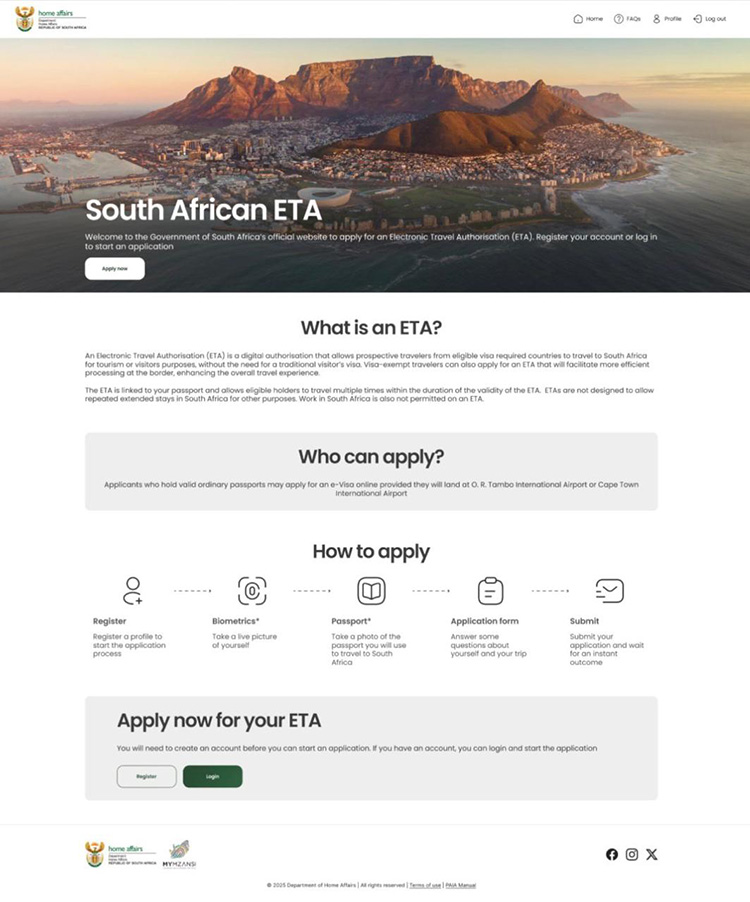
The Electronic Travel Authorisation (ETA) is a new online system that allows eligible travellers to obtain travel authorisation digitally before departing for South Africa.
The initiative forms part of the Department of Home Affairs' wider plan to modernise immigration services, reduce paperwork and replace much of the current manual visa process with a faster, more secure and more efficient digital system.
It is important to understand that an ETA is not the same as a visa. Instead, it is an electronic travel authorisation issued before departure. As with any international journey, the final decision to admit a traveller always rests with immigration officials at the port of entry.
The ETA system is being introduced in phases. At present, it is only mandatory for selected visa-required travellers from China, India, Indonesia and Mexico. The Department of Home Affairs intends to expand the platform gradually to additional visa-required nationalities, while travellers from visa-exempt countries continue to enter South Africa under the existing visa-free arrangements.


Why is a R500 processing fee being proposed? 


Under draft immigration regulations published by the Department of Home Affairs, travellers using the ETA system would pay a R500 processing fee.
According to the department, the fee would help fund the operation and maintenance of the digital platform, replace the current ETA fee waiver and reduce reliance on outsourced visa processing centres. For many travellers who currently require a visa, the new system could ultimately reduce the overall cost of obtaining permission to travel to South Africa.
At this stage, however, the fee remains a proposal. The regulations are still subject to public consultation before any implementation date can be announced.
 

Will the proposed ETA fee affect your trip?

 
Whether the proposed fee applies depends on your nationality and your current entry requirements.

Travellers from visa-exempt countries

If you hold a passport from a country that already enjoys visa-free access to South Africa for short tourist visits, your existing visa exemption remains unchanged.
Examples include travellers from:
  • Germany
  • United Kingdom
  • Ireland
  • France
  • Netherlands
  • Belgium
  • Switzerland
  • United States
  • Canada
  • Australia
  • New Zealand
Under the current proposal, these travellers would continue to enter South Africa under existing visa-free arrangements.
Should visa-exempt travellers choose to use the ETA system in the future—if it remains available to them on a voluntary basis—they would pay the proposed R500 processing fee.

Travellers from China, India, Indonesia and Mexico

The ETA is currently mandatory for selected visa-required travellers from China, India, Indonesia and Mexico. These travellers already use the electronic system instead of the traditional visa application process.
If the draft regulations are approved, applicants using the ETA platform would pay the proposed R500 processing fee.

Travellers from other visa-required countries

Visitors from countries that currently require a visa, but are not yet covered by the ETA rollout, are expected to transition to the digital platform as it expands.
For these travellers, the ETA aims to simplify the application process by allowing applications to be completed online instead of visiting visa application centres.
Some travellers who currently benefit from visa-fee exemptions could pay only the ETA processing fee, while others may pay both the applicable visa fee and the ETA processing fee, depending on the final regulations.
The Department of Home Affairs has indicated that the digital process should reduce the overall cost for many visa applicants compared with the existing outsourced application system.
 

Why is South Africa introducing an ETA?

 
South Africa is following a growing international trend towards digital border management.
Countries around the world have introduced similar electronic travel authorisation systems to improve border security, speed up immigration procedures and make travel more convenient.
By moving applications online, South Africa hopes to:
  • reduce processing times
  • improve security screening before arrival
  • modernise immigration services
  • reduce paperwork
  • reduce reliance on outsourced visa processing centres
  • make travel planning easier for legitimate visitors.
For most holidaymakers, the biggest advantage should be a more efficient application process once the system is fully operational.
 

What travellers should do now

 
If you're planning a trip to South Africa over the coming months, there's no need to change your travel plans based on the proposal alone. Unless you are travelling from one of the countries currently included in the ETA rollout—China, India, Indonesia or Mexico—the new system is unlikely to affect your immediate travel arrangements.
Before you travel:
  • Check whether your nationality requires a visa.
  • Confirm whether your country is currently part of the ETA rollout.
  • Monitor official announcements regarding the proposed R500 processing fee.
  • Use only official South African government channels when applying for visas or an ETA.
  • Apply well in advance of your departure date.
As with any change to immigration rules, requirements can evolve before the final regulations are published.
 

Frequently Asked Questions

 
Is the R500 ETA fee already in force?
No. The R500 processing fee has been proposed as part of draft regulations and is not yet in effect.

Which travellers currently need an ETA?
At present, the ETA is mandatory only for selected visa-required travellers from China, India, Indonesia and Mexico. The system is expected to expand gradually to additional visa-required nationalities.

Will visa-free travellers still be able to visit South Africa?

Yes. The proposal does not remove existing visa exemptions. Travellers from visa-exempt countries can continue to visit South Africa under the current entry rules.

Do German travellers need an ETA?
No. German passport holders remain eligible for visa-free tourist visits.

Do British travellers need an ETA?
No. UK passport holders also continue to enjoy visa-free entry for eligible short stays.
Do US travellers need an ETA?
No. US passport holders also continue to enjoy visa-free entry for eligible short stays.

Is an ETA the same as a visa?
No. An ETA is an electronic travel authorisation that forms part of South Africa's new digital immigration system. It is not a traditional visa, and immigration officials at the port of entry retain the final authority to grant or refuse entry.

When will the proposed R500 fee take effect?

There is currently no confirmed implementation date. The proposal must first complete South Africa's regulatory process before the fee can be introduced. Comments and submissions on the proposed fee structure can be made to the Department of Home Affairs before 11 August 2026.


Bottom line

South Africa's proposed R500 ETA processing fee is part of a broader effort to modernise the country's immigration system rather than introduce a new tourism tax.

For most travellers from visa-exempt countries, nothing changes for now. Those who already enjoy visa-free access can continue travelling under the existing rules while the ETA system is gradually expanded.

At present, only selected visa-required travellers from China, India, Indonesia and Mexico are required to use the ETA. If approved, the proposed R500 processing fee would apply to applications submitted through the electronic system.

As South Africa continues rolling out its digital immigration platform, travellers should always check the latest official entry requirements before departure. We'll continue monitoring developments and update this guide as soon as the final regulations—and any implementation dates—are announced. 
 
Subscribe for updates:

Subscribe to our newsletter for weekly updates, border info, road alerts, and travel inspiration for Southern Africa. 

19 March 2026

South Africa ETA 2026: Latest updates, who needs it & what travellers must know

Last update: 28 July 2028

new blogpost: South Africa's proposed R500 ETA fee explained: What international travellers need to know 

Last update: 23 July 2026

South Africa’s Electronic Travel Authorisation (ETA) system continues to evolve, although there have been no changes to the current traveller eligibility since our previous update. The system remains mandatory for selected visa-required travellers from China, India, Indonesia and Mexico, while visitors from visa-exempt countries—including Germany, the EU, the UK and the USA—continue to travel under the existing entry rules.

The most significant development since the last update is the Department of Home Affairs' confirmation that the ETA platform will also underpin additional digital immigration services. As part of the newly launched Phase II of the Trusted Employer Scheme (TES), the online application process will ultimately be integrated into the ETA platform, reinforcing its role as South Africa’s central digital immigration system rather than simply an online tourist visa tool.

While no additional traveller nationalities or ports of entry have yet been announced for the ETA, these latest developments demonstrate that the government continues to invest in the platform as the long-term foundation of a fully digital, biometric-based immigration system. For travellers, the practical entry requirements remain unchanged for now, but the ETA is steadily becoming an increasingly important part of South Africa’s broader border modernisation programme

Last updated: 28 May 2026

South Africa’s Electronic Travel Authorisation (ETA) system continues to advance steadily, with the clearest recent development being the government’s intensified focus on integrating the ETA into a broader nationwide digital identity and border modernisation programme. Since mid-May 2026, the Department of Home Affairs has accelerated rollout plans for biometric verification systems and digital traveller processing infrastructure, reinforcing the ETA’s role as the future backbone of South Africa’s visa and border management system.

Recent official communications have also placed stronger emphasis on expanding digital processing capacity ahead of wider ETA implementation at additional airports and selected land border posts. While the ETA itself remains limited to selected visa-required nationalities such as travellers from China, India, Indonesia and Mexico, authorities are increasingly positioning the platform as a long-term replacement for traditional visitor visa processing rather than a standalone pilot project.

For most international visitors, including travellers from Germany, the EU, the UK and the USA, entry requirements remain unchanged and no ETA is currently required. However, the pace of digital infrastructure development suggests that South Africa is moving more decisively toward a fully biometric, digitally managed travel system, with further ETA expansion likely during the second half of 2026. 

Last updated: 15 May 2026

South Africa’s Electronic Travel Authorisation (ETA) system continues to move beyond its original pilot phase, with several important developments emerging. Most notably, government officials and tourism authorities are now publicly presenting the ETA as the future foundation of South Africa’s entire visitor visa system, rather than simply a limited travel pilot. During Africa’s Travel Indaba 2026 in Durban, Tourism Minister Patricia de Lille again highlighted the ETA as a key tool to simplify travel and boost tourism growth.

At the same time, South Africa’s broader digital immigration infrastructure is accelerating rapidly. New biometric and digital identity systems are being rolled out nationwide, while Home Affairs continues expanding digital services and facial-recognition verification technology across airports, border systems and banking platforms. These developments strongly reinforce expectations that the ETA will steadily expand to additional nationalities and ports of entry during the remainder of 2026.

Despite this momentum, practical travel requirements remain largely unchanged for now. The ETA is still primarily limited to selected visa-required nationalities such as travellers from China, India, Indonesia and Mexico, while visa-free visitors from Germany, the EU, the UK and the USA continue to enter South Africa without needing ETA approval. However, the overall direction is now unmistakable: South Africa is rapidly building a fully digital, biometric-based border and visa system, with the ETA positioned at its centre. 

Last updated: 06 May 2026

South Africa’s Electronic Travel Authorisation (ETA) continues to expand in phased rollout, with recent government updates confirming it will become the country’s central digital visa platform in the coming years. While the ETA remains mandatory only for selected visa-required markets such as China, India, Indonesia and Mexico—and is still not required for travellers from Germany, the EU, the UK or the USA—the policy direction is now clear. Authorities are accelerating the rollout of biometric systems at airports and land borders, paving the way for wider implementation. For now, travel requirements remain unchanged for most visitors, but the ETA is steadily evolving into the default entry system for South Africa as expansion continues through 2026. 

Last updated: 16 April 2026 

South Africa’s Electronic Travel Authorisation (ETA), launched in September 2025, remains in a phased rollout and is still only partially implemented as of April 2026. It is currently mandatory for selected visa-required markets including China, India, Indonesia and Mexico, where approval must be obtained before travel, while no ETA is required for most other visitors such as travellers from Germany, the EU, the UK and the USA. Since the initial pilot at major airports like OR Tambo and Cape Town, the system has gradually expanded to additional entry points including Lanseria International Airport, with government policy now clearly indicating that the ETA will become South Africa’s central digital visa platform over time. Further expansion to more nationalities and selected border posts is expected during 2026, although the system remains transitional and not yet universally applied across all travellers or entry points.

Last updated: 19 March 2026

South Africa’s Electronic Travel Authorisation (ETA), first introduced in September 2025, marks a major shift in how travellers enter the country. Designed to replace traditional visa processes with a fast, digital alternative, the system allows visitors to apply online, upload documents and biometric data, and receive approval electronically - often within a short timeframe.

However, as of 2026, the ETA is not yet fully implemented worldwide. Instead, it is being rolled out in carefully managed phases.

The system was initially launched during a pilot phase in late 2025, focusing on G20 delegates from China, India, Indonesia, and Mexico arriving through major gateways such as OR Tambo International Airport (JNB) in Johannesburg and Cape Town International Airport (CPT) in Cape Town. This phase allowed authorities to test the platform, refine biometric verification processes, and ensure integration with South Africa’s broader border management systems.

Since then, the ETA has been expanded to include leisure travellers from these same four countries, with Lanseria International Airport (HLA), north of Randburg and Sandton, added as an additional entry point.. For travellers from these markets, the ETA is now a mandatory pre-travel requirement -meaning that without prior approval, boarding or entry into South Africa is not permitted.

For most European travellers, including those from Germany, as well as visitors from the UK and the United States, nothing has changed for now. Visa-free entry for short stays remains in place, and no ETA is currently required. That said, this is expected to evolve over time as the system expands.

From a traveller’s perspective, the ETA introduces a more streamlined and predictable process. Applications are completed online, approvals are linked directly to passports, and arrival procedures increasingly rely on biometric verification rather than manual checks. The long-term aim is to reduce queues, improve security, and remove administrative friction - particularly for visitors from high-growth tourism markets.

That said, the system is still maturing. Coverage remains limited, entry points are not yet universal, and there have been some early reports of technical teething issues. In practical terms, 2026 should be seen as a transition year, rather than a finished rollout.

Looking ahead, the direction is clear. South Africa is expected to expand the ETA to all visa-required nationalities, gradually replace traditional visitor visas, and extend the system to additional airports and land borders. There is also a strong possibility that, in the longer term, even visa-exempt travellers could be included - similar to systems being introduced in Europe and the UK.

For now, the key takeaway is simple: the ETA is live, but only for selected travellers. If you are visiting from Europe, you can continue to travel as usual. If you are travelling from one of the currently included countries, applying for an ETA in advance is essential.

South Africa’s ETA is ultimately about making travel easier - but for the moment, it remains a system in progress, and one that travellers should continue to monitor closely as it expands through 2026 and beyond.


Subscribe for updates:

Subscribe to our newsletter for weekly updates, border info, road alerts, and travel inspiration for Southern Africa. 

24 February 2026

Mozambique Travel Update 2026: New eVisa & ETA system launched as flood recovery continues

Last update 29 July 2026

We have reviewed Mozambique's digital eVisa and Electronic Travel Authorisation (ETA) system and, at the time of writing, there have been no significant policy changes since the platform was introduced in February 2026. The official online application portal remains unchanged, with the distinction between the ETA for eligible visa-exempt travellers and the eVisa for visa-required travellers continuing to apply. Travellers are still advised to apply well in advance of departure and ensure they have received the appropriate approval before travelling. We'll continue to monitor the situation and update this guide as soon as any new entry requirements or procedural changes are announced. 

Last update 16 April 2026 

Mozambique's digital eVisa and Electronic Travel Authorisation (ETA) system, introduced in February 2026, is now fully operational and has largely stabilised. The unified online platform continues to process both eVisas and ETAs, with authorities maintaining a clear distinction between the two: the ETA serves as pre-travel authorisation for eligible visa-exempt travellers, while the eVisa remains a full electronic visa for those requiring one. Since rollout, the main developments have been operational rather than policy-driven, with improved system clarity, more consistent enforcement at airline check-in and border control, and stricter verification of supporting documents such as return tickets and accommodation details. Processing times remain broadly unchanged, with ETAs typically requiring submission at least 48 hours before travel and eVisas taking several business days depending on the application category. Overall, the system is now functioning more reliably than during the initial launch phase, and travellers should ensure they obtain the correct approval before departure, as airlines are increasingly enforcing strict compliance at boarding. 

----------------- 

Mozambique has introduced a new digital eVisa and Electronic Travel Authorisation (ETA) system in February 2026, significantly modernising its entry procedures for international visitors. The reform simplifies border processing and reduces historic uncertainty at land crossings - particularly important for self-drive and safari-and-beach travellers.

The rollout comes as the country continues recovering from a severe 2025–26 rainy season, compounded by heavy rainfall linked to Cyclone Gezani.

Mozambique eVisa & ETA 2026: What travellers must check before departure

Mozambique's new digital entry framework includes two separate mechanisms - and travellers must confirm which applies to their nationality before departure.

eVisa (Electronic Visa)

An eVisa is a full visa issued digitally prior to travel.

It generally applies to:
  • Nationalities that previously required a visa in advance
  • Longer stays or specific travel categories
The process typically involves:
  • Completing an online application
  • Uploading passport and supporting documentation
  • Paying the visa fee electronically
  • Receiving formal digital visa approval
  • Presenting the eVisa upon arrival
Processing times vary, so applications should be submitted well ahead of travel.

ETA (Electronic Travel Authorisation)

An ETA is not a traditional visa. It is a digital pre-travel authorisation linked electronically to your passport.

It generally applies to:
  • Visa-exempt nationalities
  • Short-term tourist visits
The ETA requires:
  • Online registration before departure
  • Confirmation prior to boarding

While simpler than an eVisa, it still requires action before travel. Arriving without the correct digital authorisation may result in delays at air or land borders.

For travellers combining South Africa and Mozambique by road, the system removes much of the previous paperwork uncertainty — but shifts responsibility to travellers to prepare digitally in advance.

Mozambique flooding update – February 2026

The 2025–26 rainy season brought record rainfall to central and southern Mozambique, particularly affecting parts of Gaza, Inhambane, Sofala and Maputo provinces. Hundreds of thousands of residents were impacted, and significant damage occurred to secondary roads, bridges and local infrastructure.

While major airports and primary tourism hubs remain operational, recovery work is ongoing in several inland and rural districts. Some secondary road corridors continue to experience slower travel times due to repair work.

Key travel considerations:

  • International airports are operating normally
  • Major beach resorts and safari lodges remain open
  • Some inland road access routes require condition checks before departure
  • Infrastructure restoration is progressing but not yet fully complete in all districts

Northern Mozambique has been comparatively less affected and remains a stable option for travellers seeking beach and marine experiences.

Cyclone Gezani
 

Cyclone Gezani did not make direct landfall in Mozambique. However, its offshore passage intensified rainfall and generated rough coastal seas, temporarily slowing flood recovery efforts and affecting marine conditions.

Short-term impacts included:

  • Rough sea conditions affecting diving and boat transfers
  • Temporary weather-related delays to coastal activities
  • Localised transport disruptions in already flood-affected areas

There has been no nationwide collapse of tourism infrastructure, but weather-related flexibility remains advisable in certain southern and coastal regions.

What this means for international travellers in 2026

If you are planning travel to Mozambique this year:

  • Confirm whether you require an eVisa or ETA
  • Apply or register well before departure
  • Allow flexibility if travelling through southern or central provinces
  • Verify road conditions for long self-drive transfers
  • Consider routing through major air gateways where possible
  • Ensure comprehensive travel insurance covers weather-related disruption
  • Maintain malaria precautions where applicable

For most leisure travellers - particularly those flying into primary hubs - Mozambique remains open and accessible.

Bottom line

Mozambique is open for tourism, and the launch of the digital eVisa and ETA system represents a meaningful structural improvement for international visitors.

However, parts of the country are still recovering from severe flooding during the 2025–26 rainy season, with additional rainfall linked to Cyclone Gezani slowing repair operations in some areas. Travel in affected southern and inland regions requires flexible planning and up-to-date route verification.

For safari-and-beach travellers combining South Africa and Mozambique, conditions are manageable - but advance digital entry preparation and smart routing are essential.


Subscribe for updates:

Subscribe to our newsletter for weekly updates, border info, road alerts, and travel inspiration for Southern Africa.  
19 December 2025

Mozambique pre-travel registration: What travellers should know!

Travellers planning a visit to Mozambique should be aware of the country’s pre-travel registration and Electronic Travel Authorisation (ETA) framework, which was formally introduced under Decree No. 10/2023.

While the regulation provides for mandatory online pre-travel registration for visa-exempt nationals, the requirement is currently not enforced. Mozambique’s immigration authorities suspended implementation in May 2025 after technical issues affected the online registration platform.

Current Position for Travellers
At present:

  • The ETA requirement remains in force in law
  • Online pre-travel registration is suspended
  • Visa-exempt travellers may enter Mozambique without completing an ETA
  • No official date has been announced for the reinstatement of the system.

Entry requirements still apply
Despite the suspension, travellers must still meet standard entry conditions, including:

Payment of any applicable entry fees on arrival, if requested

Key takeaway
Mozambique’s pre-travel registration system exists legally but is paused operationally. Travellers should check for official guidance shortly before departure, as the requirement may be reinstated at short notice.

We will continue to monitor and report on any changes affecting travel to Mozambique.


Subscribe for updates:

Subscribe to our newsletter for weekly updates, border info, road alerts, and travel inspiration for Southern Africa. 

19 September 2025

South Africa launches new Electronic Travel Authorisation (ETA) with phased rollout for tourists!

South Africa has taken a major step towards streamlining international travel! On 18 September 2025, the country's Minister of Home Affairs, Dr. Leon Schreiber, officially unveiled the country’s brand-new Electronic Travel Authorisation (ETA) at the Tourism Business Council of South Africa’s Leadership Conference in Sun City.
The ETA system is designed to replace outdated paper-based visa processes with a secure, fully digital, and traveller-friendly platform. Visitors will soon be able to apply online, capture their biometrics, and receive near-instant approval - eliminating long processing times and complicated paperwork. The ETA will be powered by the new Electronic Movement Control System (EMCS 2.0), which uses facial recognition at ports of entry, starting at OR Tambo International Airport (JNB) in Johannesburg and Cape Town International Airport (CPT) in Cape Town. This means faster arrivals, shorter queues, and enhanced national security through automated biometric checks.

ETA ollout timeline:

  • Phase 1 (September - October 2025): Exclusive launch for G20 delegates from China, India, Indonesia, and Mexico. Applications open mid-October, allowing delegates to use the system ahead of the G20 Leaders’ Summit in Johannesburg from 14–16 November 2025.
  • Phase 2 (Post-Summit): If stable, ETA access will open to the general public from the same four countries. Payment integration will go live, allowing tourists to apply and pay digitally before travelling.
  • Phase 3 (2026 onwards): Gradual global rollout to all visa-requiring markets, with expansion to additional airports, land borders, and smaller ports of entry as infrastructure scales up.


South Africa also plans to expand the ETA to more visa categories over time, with fully automated entry and exit procedures eventually available at all ports of entry.

This digital transformation promises a seamless travel experience for international visitors, positioning South Africa as a more competitive and tourist-friendly destination on the global stage.

Passport holders who are exemot from visas for South Africa >> 


 Subscribe for updates:

Subscribe to our newsletter for weekly updates, border info, road alerts, and travel inspiration for Southern Africa.  

20 May 2025

Mozambique temporarily suspends new pre-travel registration requirement for visa-exempt travellers! [update #6]

update (22 October 2025): As of 22 October 2025, Mozambique's pre-travel registration requirement for visa-exempt travelers remains temporarily suspended. 

update (08 October 2025): As of early October 2025, Mozambique's pre-travel registration for visa-exempt travelers remains suspended and there is no electronic registration required to enter the country until further notice. 

update (18 September 2025): The 48-hour pre-travel registration requirement is still temporarily suspended! 

update (25 August 2025):  The 48-hour pre-travel registration requirement for travellers from 29 visa-exempt countries to Mozambique is still suspended.

update (29 July 2025):  The 48-hour pre-travel registration requirement for travellers from 29 visa-exempt countries to Mozambique is still suspended.

update (16 July 2025): The 48-hour pre-travel registration requirement for travellers from 29 visa-exempt countries to Mozambique remains suspended. It’s advisable to monitor updates from Mozambique’s immigration service, but for now, entry is permitted under the visa exemption without the Electronic Travel Authorization (ETA)

The Mozambican National Migration Service (SENAMI) announced on 16 May 2025 that the newly introduced requirement for travellers from select visa-exempt countries to submit travel information at least 48 hours before entering Mozambique has been temporarily suspended.
This suspension comes as a result of technical issues affecting the registration system, which have disrupted access and data submission for travellers subject to the rule. SENAMI emphasized that the decision was made to avoid inconveniences for affected visitors until the system is fully operational.

12 May 2025

Mozambique travel update: New Electronic Travel Authorization (ETA) requirement for visa-exempt visitors!

Mozambique has implemented a significant travel update, requiring all visa-exempt travellers to secure an Electronic Travel Authorization (ETA) at least 48 hours before their scheduled departure. Previously optional, this electronic travel formality is now a mandatory prerequisite for legal entry into Mozambique. Travellers can complete the ETA registration through the official platform at www.evisa.gov.mz by providing personal information, passport details, and planned stay specifics.

The new ETA requirement applies to citizens of the following 29 countries:

  1. Canada
  2. Switzerland
  3. United Arab Emirates
  4. Israel
  5. United States
  6. Russia
  7. Japan
  8. Saudi Arabia
  9. Belgium
  10. Denmark
  11. Spain
  12. Norway
  13. Sweden
  14. Netherlands
  15. United Kingdom
  16. South Korea
  17. Ivory Coast
  18. Finland
  19. Indonesia
  20. Ireland
  21. Singapore
  22. Ghana
  23. Senegal
  24. Germany
  25. France
  26. Italy
  27. China
  28. Portugal
  29. Ukraine

While the ETA is not a visa application, it is a mandatory legal entry notification that must be obtained and approved before travel. Once the application is completed, travellers can download the approved ETA within minutes. The document is valid for three months from the approval date.

Upon arrival, visa-exempt travellers must pay a processing fee of 650 Mozambican Meticais (MZN), either in local currency or in a foreign currency recognized by Mozambican authorities. Failure to register and pay the fee in advance may result in denied boarding or entry.

Travellers must present the following documents upon arrival in Mozambique:

  • Approved ETA (digital or printed copy)
  • Passport valid for at least six months
  • Supporting documentation for the purpose of the visit:
    • Tourism: Proof of accommodation, return ticket, evidence of sufficient funds
    • Business: Invitation letter, return ticket, proof of financial means