update (28 October 2019): CapeNature's Anysberg Nature Reserve in the western Klein Karoo will remain closed until 30 April 2020. This is due to the ongoing drought in the Western Cape
and the severe water shortage at Anysberg. If there is adequate
rainfall before that date, there will be further communication on a
possible earlier opening.
update (02 October 2019): CapeNature's Anysberg Nature Reserve in the western Klein Karoo will remain closed for the rest of the year and will only re-open on 01 January 2019. This is due to the ongoing drought in the Western Cape and the severe water shortage at Anysberg. If there is adequate rainfall before that date, there will be further communication on a possible earlier opening.
Due to the ongoing drought in the Western Cape, there is a severe water shortage at Anysberg in the western Klein Karoo. CapeNature, the public institution with the statutory responsibility for biodiversity conservation in South Africa's Western Cape, has closed the Anysberg Nature Reserve, including all accommodation, until 30 September 2019. If there is adequate rainfall before that date, CapeNature might consider to re-open the Nature Reserve earlier.
Anysberg Nature Reserve is located between the towns of Ladismith, Laingsburg, Touwsrivier and Montagu in the Klein Karoo. The World Heritage Site encompasses 79 629 hectares of plains and the majestic Cape Fold Mountains. Fed by three rivers, a diversity of life is supported here amid mountain fynbos and the characteristic veld of the Klein Karoo.
Showing posts with label drought. Show all posts
Showing posts with label drought. Show all posts


03 December 2018
Addo Elephant National Park: Emergency upgrades to several waterholes in the main game viewing areas!
South African National Parks (SANParks) just announced that due to the drought and lack of rainfall essential and emergency upgrades to several waterholes in the main game viewing areas of Addo Elephant National Park (Main Camp area and Colchester area) will be undertaken over the next two weeks. This unfortunately involves heavy machinery and loud noise at the waterholes, which will affect the visitors' experiences and, of course, the animal behaviour. Several trenches will be dug in the process and will remain open for at least four to five days.


29 November 2018
Cape Town to relax water restrictions from 01 December 2018!
The City of Cape Town is set to relax water restrictions in Cape Town from the current level 5 to level 3. As of 01 December 2018, the water usage target in the Mother City will be increased from 70 litres to 105 litres per person per day and the daily collective consumption target will increase by 150 million litres to 650 million litres to ensure that water conservation efforts remain in place. This decision to lower restrictions comes after a meeting between the South Africa's National Department of Water and Sanitation and the water users of the Western Cape Water Supply System, namely the agricultural sector, Western Cape Government, municipalities and the Cape Town metro regarding the water assessment for the year ahead.
From 1 December water restrictions and tariffs will be lowered to Level 3 thanks to the effective water saving habits of CT residents and increase in dam levels. We encourage residents to continue using water responsibly. Find out more here: https://t.co/zubt4bRBaw #ThinkWaterCT pic.twitter.com/nGoLcYjClH— City of Cape Town (@CityofCT) November 29, 2018
10 September 2018
Cape Town to relax water restrictions!
The City of Cape Town has announced that it will be relaxing its water restrictions by moving from the currenty Level 6B to Level 5. As of 01 October 2018, the water usage target in Cape Town will be increased from 50 litres to 70 litres per person per day and the daily collective consumption target will increase by 50 million litres to 500 million litres to ensure that water conservation efforts remain in place.
The Western Cape Water Supply System's dams are currently nearing 70% of storage capacity, a very significant improvement on the situation at the end of the previous winter, when they were at 38% capacity. Rainfall remains highly variable, and while May and June saw rainfall close to that of an average year, July had very poor rainfall. This improved somewhat in August and so far in September the positive trend continues.
The Western Cape Water Supply System's dams are currently nearing 70% of storage capacity, a very significant improvement on the situation at the end of the previous winter, when they were at 38% capacity. Rainfall remains highly variable, and while May and June saw rainfall close to that of an average year, July had very poor rainfall. This improved somewhat in August and so far in September the positive trend continues.
29 June 2018
Cape Town: No Day Zero for 2019!
update (11 July 2018): The City of Cape Town has released an informative video regarding the "Day Zero" postponement!
The City of Cape Town is confident that there will be no prospect of reaching Day Zero in 2019. According to a statement by Executive Deputy Major Alderman Ian Neilson, the levels of the dams supplying water to Cape Town have been rising consistently and significantly over the past six weeks. As at today (28 June 2018), total dam storage capacity is at just over 43%, and Cape Town and the surrounding region are expecting more than two more months of winter rainfall. The drought, however, is still ongoing, and the City of Cape Town also announced that its stringent water restrictions are to be maintained.
The City of Cape Town is confident that there will be no prospect of reaching Day Zero in 2019. According to a statement by Executive Deputy Major Alderman Ian Neilson, the levels of the dams supplying water to Cape Town have been rising consistently and significantly over the past six weeks. As at today (28 June 2018), total dam storage capacity is at just over 43%, and Cape Town and the surrounding region are expecting more than two more months of winter rainfall. The drought, however, is still ongoing, and the City of Cape Town also announced that its stringent water restrictions are to be maintained.
Having analysed this new data, we are now in a position to state that not only have we managed to avoid Day Zero this year, but we will also safely get through summer in 2019. This is due to the amount of water already in the dams, our intense water demand management programmes, our unrelenting communication, awareness and the behavioural change it has effected over the past two years, as well as the continued support and sacrifice of Team Cape Town. (Executive Deputy Major Alderman Ian Neilson, 28 June 2018)
08 March 2018
Cape Town: "Day Zero" has been pushed out to 2019!
According to the City of Cape Town, "Day Zero" has now moved - if Capetonians and visitors continue their current water savings efforts - from 09 July 2018 to 2019. In case Cape Town will not experience any rainfall, "Day Zero" is projected to arrive on 27 August 2018. As this date falls deep within the normal rainfall period, it is no longer appropriate to project the date without any consideration of rainfall. The City of Cape Town urges all Capetonians (and, of course, all visitors) not to relax their savings efforts as it is not possible to predict the volume of rainfall still to come. We'll keep you posted!
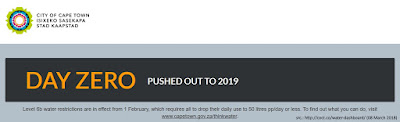
On "Day Zero" taps in homes and businesses in Cape Town will be turned off until the rains come. The city's (at least) four million residents will have to line up for water rations at 200 collection points.

On "Day Zero" taps in homes and businesses in Cape Town will be turned off until the rains come. The city's (at least) four million residents will have to line up for water rations at 200 collection points.
05 March 2018
Cape Town: "Day Zero" has been pushed back to 15 July 2018!
According to City of Cape Town's water dashboard, "Day Zero" has now moved from 09 July 2018 to 15 July 2018.

On "Day Zero" taps in homes and businesses in Cape Town will be turned off until the rains come. The city's (at least) four million residents will have to line up for water rations at 200 collection points.

On "Day Zero" taps in homes and businesses in Cape Town will be turned off until the rains come. The city's (at least) four million residents will have to line up for water rations at 200 collection points.
20 February 2018
Cape Town: "Day Zero" has been pushed back to 09 July 2018!
According to a new statement by the City of Cape Town, "Day Zero" has now moved from 04 June 2018 to 09 July 2018 due to a weekly drop in dam levels of only 0.5% (as compared to a 1.9% drop in 2014). This week's reduced water consumption as well as the Groenland water donation to the Steenbras Upper Dam has helped pushing back the date.
On "Day Zero" taps in homes and businesses in Cape Town will be turned off until the rains come. The city's (at least) four million residents will have to line up for water rations at 200 collection points.
On "Day Zero" taps in homes and businesses in Cape Town will be turned off until the rains come. The city's (at least) four million residents will have to line up for water rations at 200 collection points.
13 February 2018
Cape Town: "Day Zero" pushed out to the beginning of June 2018!
According to a new statement by the City of Cape Town, "Day Zero" is expected to move out from to 11 May 2018 to 04 June 2018 due to a decline in agricultural usage, and also as a result of Capetonians reducing their water usage in cooperation with the City of Cape Town's efforts to bring down consumption.
On "Day Zero" taps in homes and businesses in Cape Town will be turned off until the rains come. The city's (at least) four million residents will have to line up for water rations at 200 collection points.
On "Day Zero" taps in homes and businesses in Cape Town will be turned off until the rains come. The city's (at least) four million residents will have to line up for water rations at 200 collection points.
09 February 2018
Cape Town Drought: What travellers need to know! (info sheet)
WESGRO, the official Tourism, Trade & Investment Promotion Agency for Cape Town & Western Cape, has released some very useful information regarding the drought Cape Town and the Western Cape are currently experiencing. Please download the info sheet (pdf) for a list of answers to FAQs on the drought.
 |
| via http://www.wesgro.co.za/ |
05 February 2018
Cape Town: "Day Zero" pushed out to mid-May 2018!
According to a statement by the City of Cape Town, "Day Zero" is expected to move out from mid-April 2018 to 11 May 2018 due to a decline in agricultural usage. There has not been any significant decline in urban usage. All Capetonians, and, of course, all the visitors to Cape Town, must therefore continue to use no more than 50 litres per person per day to help stretch our dwindling supplies.
On "Day Zero" taps in homes and businesses in Cape Town will be turned off until the rains come. The city's (at least) four million residents will have to line up for water rations at 200 collection points.
On "Day Zero" taps in homes and businesses in Cape Town will be turned off until the rains come. The city's (at least) four million residents will have to line up for water rations at 200 collection points.
15 November 2017
SANParks has implemented water saving measures in Table Mountain National Park!
South African National Parks (SANParks) has implemented water saving measures at picnic areas in Cape Town's Table Mountain National Park (TMNP). The picnic areas include Bordtjiesdrift and Buffelsbay in Cape Point, Boulders as well as Tokai, Silvermine and Oudekraal. SANParks will continue to monitor the situation with regards to the water crisis and take necessary measures as required.
Some of the measures are:

- Waterless hand sanitation products, especially in the toilet facilities in Cape Point.
- A reduction in the number of outdoor taps at picnic sites
- The immediate closure of all outdoor shower facilities at picnic sites and coastal beaches
- Visitors, especially those that are using the picnic sites, are encouraged to bring water from home
- SANPArks encourages picnic site users, especially those wishing to braai, to ensure that they don’t leave fires unattended and put their fires out once they have finished braaiing.
- Park users are encouraged to report leaking taps, pipes etc in the park to the closest TMNP office.
Subscribe to:
Posts (Atom)