Showing posts with label Convention on Wetlands of International Importance. Show all posts

19 February 2025

Eastern Cape: Mkambati Nature Reserve declared South Africa's 31st Ramsar site!

The Mkambati Nature Reserve in South Africa's Eastern Cape has officially been recognized as a Wetland of International Importance (Ramsar Site) by the Ramsar Convention. With this designation, the number of Ramsar Sites in the country now stands at 31.
Located along the Wild Coast, approximately 71km from Flagstaff, Mkambati Nature Reserve spans 7,720 hectares and is named after the rare Mkambathi Palm (Jubaeopsis caffra). The reserve features vast open grasslands, deep scarp forest ravines, and an intricate network of rivers, streams, marshlands, swamp forests, and waterfalls. The Msikaba River and the Mtentu River, with their open estuaries, form the northern and southern boundaries of the reserve, while a 13km stretch of untouched coastline lies between them. The Mtentu River is also home to small but significant patches of mangrove forest.
Additionally, the Gwegwe estuary and Mgcetyana estuarywithin the reserve flow into the Indian Ocean and the Pondoland Marine Protected Area. Notably, Mkambati Nature Reserve is home to the Mkambati Falls, one of the few waterfalls in the world that plunge directly into the ocean—making this protected area truly unique.

The Convention on Wetlands/Ramsar Convention is an intergovernmental treaty that embodies the commitments of its member countries to maintain the ecological character of their Wetlands of International Importance and to plan for the "wise use", or sustainable use, of all of the wetlands in their territories.  

06 February 2024

Mpumalanga: De Berg Nature Reserve declared South Africa’s 30th Ramsar site!

The De Berg Nature Reserve in Mpumalanga has been declared a Wetland of International Importance ("Ramsar Site") by the Convention on Wetlands of International Importance, also known as the Ramsar Convention. This addition brings the number of South Africa's Ramsar Sites to 30.
The De Berg Nature Reserve is located along the headwaters of the Dwars River about 20 kilometres north of the town of Dullstroom and lies adjacent to the Verloren Valei Ramsar Site. At an elevation of just over 2300 meters above sea level, the Nature Reserve contains the highest altitude wetlands in Mpumalanga. It consists of numerous valley bottom, seep wetlands and mountain streams and represents some of the most pristine and habitat diverse watercourses in the South African grassland biome.

The Convention on Wetlands/Ramsar Convention is an intergovernmental treaty that embodies the commitments of its member countries to maintain the ecological character of their Wetlands of International Importance and to plan for the "wise use", or sustainable use, of all of the wetlands in their territories. 

06 April 2023

Mpumalanga: Middelpunt Nature Reserve declared as South Africa’s 29th Ramsar site!

The Middelpunt Nature Reserve in Mpumalanga has been declared a Wetland of International Importance ("Ramsar Site") by the Convention on Wetlands of International Importance, also known as the Ramsar Convention. This addition brings the number of South Africa's Ramsar Sites to 29. The Middelpunt Nature Reserve is located along the headwaters of Lakenvleispruit, a stream in the Olifants River basin, approximately 14 kilometres from the town of Dullstroom.
The Nature Reserve is situated in one of South Africa's highest rainfall regions known as the Mpumalanga Drakensburg Strategic Water Source Area (SWSA), which consists primarily of a permanent freshwater valley bottom wetland, supported by lateral seeps and artesian springs. It is home to one of the rarest and most threatened water birds in Africa, the White-winged Flufftail, as well as to a number of other endangered and endemic species, including the Blue Crane, Secretary Bird, African Grass Owl, and Denham's Bustard. The Middelpunt Nature Reserve is one of just two in South Africa where the rare peat borrowing crab is found.

The Convention on Wetlands/Ramsar Convention is an intergovernmental treaty that embodies the commitments of its member countries to maintain the ecological character of their Wetlands of International Importance and to plan for the "wise use", or sustainable use, of all of the wetlands in their territories.
04 February 2022

The Berg Estuary in the Western Cape designated as South Africa’s 28th Ramsar Site! [update]

update (08 June 2022): An official Ramsar sign board located at the start of the Berg Estuary was unveiled recently by the Western Cape government and CapeNature at the launch of the Berg Estuary as a Ramsar site

The Berg Estuary in South Africa's Western Cape has been declared a Wetland of International Importance ("Ramsar Site") by the Convention on Wetlands of International Importance, also known as the Ramsar Convention. This addition brings the number of South Africa's Ramsar Sites to 28.
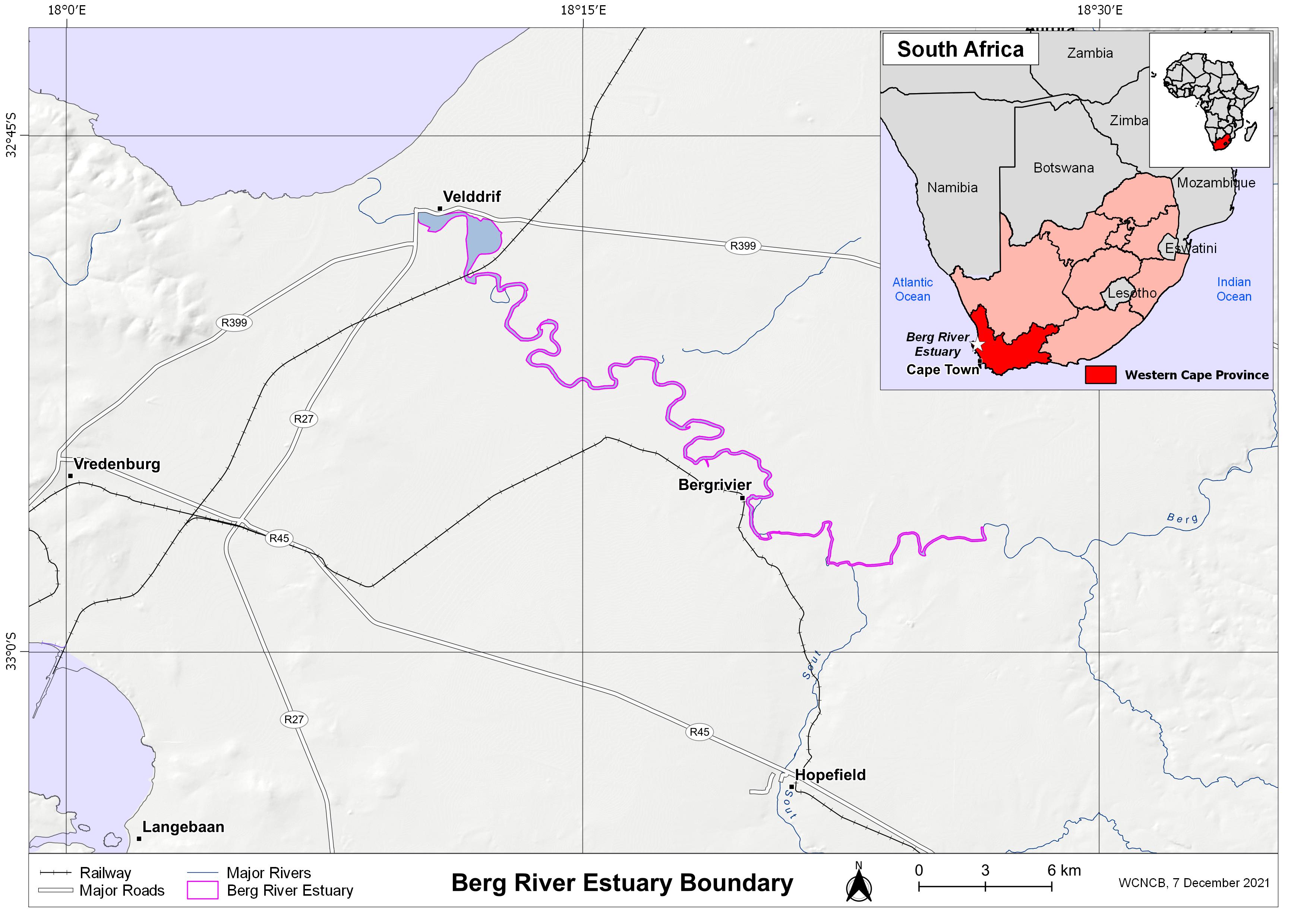
Situated at Velddrif, close to St Helena Bay where the Berg River flows into the sea, this estuary spans an area of 1 162 ha. The Berg Estuary is one of the most important coastal wetlands in South Africa. Fresh water flowing from the estuary and its floodplain mixes with marine water, enabling diverse conditions for various habitats to flourish. Among these is the third-largest saltmarsh on the Cape Coast. The estuary's unique vegetation is a valuable natural asset because of its rare plant species which are typical of the wider region. About 127 species of waterbird have been recorded since 1975, some of which are globally threatened. Despite its value, the Berg Estuary lacks an official national conservation status. However, there is a management plan which identifies research and monitoring priorities.

Berg River Estuary Boundary ©ramsar.org

The Berg Estuary, which is one of 290 estuaries in South Africa, is the second wetland of international importance to be declared in the country in two years. In 2021, the Ingula Nature Reserve in the northern Drakensberg was declared the country’s 27th Ramsar Site.

The Convention on Wetlands/Ramsar Convention is an intergovernmental treaty that embodies the commitments of its member countries to maintain the ecological character of their Wetlands of International Importance and to plan for the "wise use", or sustainable use, of all of the wetlands in their territories.

07 May 2021

Ingula Nature Reserve designated as South Africa’s 27th Ramsar Site!

The Ingula Nature Reserve in South Africa has been declared a Wetland of International Importance ("Ramsar Site") by the Convention on Wetlands of International Importance, also known as the Ramsar Convention. This addition brings the number of South Africa's Ramsar Sites to 27 covering a surface area of 571,089 hectares.
The Ingula Nature Reserve sits along the northernmost part of the Drakensberg mountain range, between Free State and KwaZulu-Natal. It lies between 1,260 and 1,900 metres above sea level, and mainly consists of dry grassy plains – which are partly cultivated and irrigated – interspersed with extensive wetlands. The Ingula Nature Reserve is home to over 300 bird species, of which 24 are threatened, 34 mammal species, including 11 carnivores and 10 antelope species, as well as 69 butterflies and 29 reptiles.
The Convention on Wetlands/Ramsar Convention is an intergovernmental treaty that embodies the commitments of its member countries to maintain the ecological character of their Wetlands of International Importance and to plan for the "wise use", or sustainable use, of all of the wetlands in their territories. 

Annotated List of Wetlands of International Importance/Ramsar Sites in South Africa:

  1. Barberspan
  2. Blesbokspruit
  3. Bot - Kleinmond Estuarine System
  4. Dassen Island Nature Reserve
  5. De Hoop Vlei
  6. De Mond
  7. Dyer Island Provincial Nature Reserve and Geyser Island Provincial Nature Reserve
  8. False Bay Nature Reserve
  9. Ingula Nature Reserve
  10. Kgaswane Mountain Reserve
  11. Kosi Bay
  12. Lake Sibaya
  13. Langebaan
  14. Makuleke Wetlands
  15. Natal Drakensberg Park
  16. Ndumo Game Reserve
  17. Ntsikeni Nature Reserve
  18. Nylsvley Nature Reserve
  19. Orange River Mouth
  20. Prince Edward Islands
  21. Seekoeivlei Nature Reserve
  22. St. Lucia System
  23. Turtle Beaches/Coral Reefs of Tongaland
  24. uMgeni Vlei Nature Reserve
  25. Verloren Valei Nature Reserve
  26. Verlorenvlei
  27. Wilderness Lakes