Showing posts with label eu. Show all posts

04 October 2022

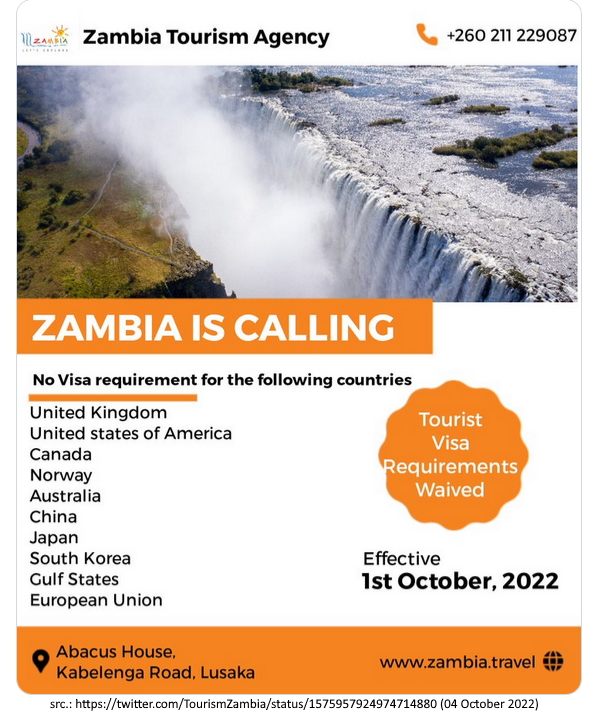
Zambia waives tourist visa requirements for several countries! [update]

update (09 January 2023): According to a statutory instrument issued by the Zambian Government on 02 November 2022, the following 43 countries are on the list of visa-exempt countries. Visa-exempt nationals are allowed to remain in Zambia up to 30 days with an option to extend up to 90 days. The following countries are exempt from visa requirements:
Australia, Canada, Norway, Japan, South Korea, New Zealand, US, UK, Austria, Belgium, Bulgaria, Croatia, Cyprus, Czech Republic, Denmark, Estonia, Finland, France, Germany, Greece, Hungary, Ireland, Italy, Latvia, Lithuania, Luxembourg, Malta, the Netherlands, Poland, Portugal, Romania, Slovakia, Slovenia, Spain, Sweden, Oman, Saudi Arabia, Iraq, Kuwait, Bahrain, Qatar, United Arab Emirates and China

The Zambia Tourism Agency announced on 30 September 2022 that Zambia has waived tourist visa requirements for citizens from several countries in a bid to boost tourism. Effective since 01 October 2022, citizens of the United Kingdom, the United States of America, Canada, Norway, Australia, China, South Korea, Gulf States and the European Union no longer need a tourist visa to visit Zambia


26 November 2021

New Covid-19 variant: The European Union considers to stop all air travel from Southern Africa! [update]

update (11 January 2022): According to a tweet by the French Presidency of the Council of the European Union, the member states of the European Union (EU) have agreed on 10 January 2022 at a Integrated Political Crisis Response (IPCR) meeting to lift the emergency break to allow air travel to resume with southern African countries. Travellers from this area will still be subject to the health measures applicable to travellers from third countries.

update (28 November 2021): Denmark has temporarily banned non-essential travel to South Africa, Lesotho, Botswana, Zimbabwe, Mozambique, Namibia and Eswatini.
Greece has restricted travelers from South Africa, Lesotho, Botswana, Zimbabwe, Mozambique, Namibia, Eswatini and Malawi to only those with essential reasons and after negative testing. All travelers from these countries will undergo a second test upon their arrival to the country and will be quarantined for 10 days.
Italy is banning entry to those who have been in South Africa, Lesotho, Botswana, Zimbabwe, Mozambique, Namibia and Eswatini in the past 14 days.
Spain is restricting flights from South Africa and Botswana.
Switzerland has banned direct flights from South Africa and the surrounding region (Botswana, Eswatini, Lesotho, Namibia, Zimbabwe).

update (27 November 2021): All 27 member states of the European Union agreed on 26 November 2021 to temporarily suspend travel from South Africa, Lesotho, Botswana, Zimbabwe, Mozambique, Namibia and Eswatini. over the outbreak of a new coronavirus variant. This ban should remain in place "until we have a clear understanding about the danger posed by this new variant," European Commission president, Ursula von der Leyen, said in a press release.

update (26 November 2021): Malta is to ban travel to and from South Africa, Botswana, Lesotho, Eswatini, Zimbabwe and Namibia. The ban becomes effective at midnight on 27 November 2021.
Croatia is planning to ban arrivals from South Africa, Lesotho, Botswana, Zimbabwe, Mozambique, Namibia or Eswatini.

update (26 November 2021): The Netherlands have halted flights from South Africa, Botswana, Lesotho, Eswatini, Zimbabwe and Namibia.
In France, authorities have temporarily suspended flights from Southern Africa for 48 hours.
Austria has issued an entry ban on flights from South Africa, Lesotho, Botswana, Zimbabwe, Mozambique, Namibia or Eswatini. The ban becomes effective at midnight today (26 November 2021). Citizens of Austria returning from these countries are allowed to enter Austria, but have to provide a PCR test result, register with the authorities and quarantine for ten days. Austria categorizes South Africa, Lesotho, Botswana, Zimbabwe, Mozambique, Namibia or Eswatini as virus variant areas.

update (26 November 2021): Italy has imposed an entry ban on people who have visited South Africa, Lesotho, Botswana, Zimbabwe, Mozambique, Namibia or Eswatini in the last 14 days. The Czech Republic's ban will begin on 27 November 2021 and will apply to third country citizens who spent more than 12 hours in the past 14 days in Southern Africa. The travel ban also includes Zambia.

The President of the European Commission*, Ursula von der Leyen, has announced that the European Commission will propose a travel ban from Southern Africa follwing the detection of a new Covid-19 variant, B.1.1.529, in South Africa that is feared to be the worst Covid-19 variant yet identified. According to a tweet by Mrs. von der Leyen, the European Commission "will propose, in close coordination with member states, to activate the emergency brake to stop air travel from the southern African region due to the variant of concern B.1.1.529." We'll keep you posted!

*The European Commission (EC) is the executive branch of the European Union (EU).
01 July 2020

Coronavirus pandemic: Rwanda is the first country in sub-Sahara Africa allowed to travel to the European Union again!

According to a press release by the Council of the European Union (EU), Rwanda is the only nation in sub-Saharan Africa that appears on a list of 14 countries that are allowed again to travel to the EU. As from today (01 July 2020), the member states of the EU start lifting the temprary travel restrictions at the external borders for residents of Rwanda. Rwandans have been banned from entering the EU since 17 March 2020 in line with an EU-wide travel restriction on all non-essential travel from third countries into the EU as a measure to curb the spread of the coronavirus.

As of 01 July 2020, citizens of the following third countries are allowed to travel to the European Union again:

  • Algeria
  • Australia
  • Canada
  • Georgia
  • Japan
  • Montenegro
  • Morocco
  • New Zealand
  • Rwanda
  • Serbia
  • South Korea
  • Thailand
  • Tunisia
  • Uruguay
  • China, subject to confirmation of reciprocity
This list is being reviewed and, as the case may be, updated every two weeks.

The countries were chosen based on certain criteria, such as the epidemiological situation and containment measures, including physical distancing, as well as economic and social considerations.
Regarding the epidemiological situation, third countries listed should meet the following criteria, in particular:

  • number of new COVID-19 cases over the last 14 days and per 100 000 inhabitants close to or below the EU average (as it stood on 15 June 2020)
  • stable or decreasing trend of new cases over this period in comparison to the previous 14 days
  • overall response to COVID-19 taking into account available information, including on aspects such as testing, surveillance, contact tracing, containment, treatment and reporting, as well as the reliability of the information and, if needed, the total average score for International Health Regulations (IHR). Information provided by EU delegations on these aspects should also be taken into account.
Reciprocity should also be taken into account regularly and on a case-by-case basis.

14 March 2012

European Union announces firm restrictions on rhino horn trade

The current situation in Southern Africa as well as the fact that organised crime operators have been active across the European Union to acquire and trade rhino horns, caused the European Commission today (14 March 2012) to announce further restrictions on the export of rhino horn across the European Union. According to the "Guidance document on export and re-export of rhinoceros horns" (pdf) nearly all future applications for the export of rhino horn will be refused and licenses will only be granted if buyers and sellers meet stringent criteria.

From 14 March 2012, all applications to re-export products made from rhino horn will no longer be granted unless they meet at least one of the following criteria:
  • The item is part of a genuine exchange between reputable institutions (i.e. museums);
  • The item is an heirloom moving as part of a family relocation; or
  • The item is part of a bone fide research project.
Additional requirements apply in relation to (re-)export to China: applications for export or re-export permits for rhino horns to China should be refused given that the domestic legislation in China prohibits import and internal trade of rhino horns.

A first step in to the right direction! Thank you, EU!

23 November 2009

EU: New air passenger compensation rights

Airline passengers who are delayed by more than three hours should get the same compensation as if their flights have been cancelled, European judges have ruled. The regulation provides that, in the event of cancellation of a flight, passengers are entitled to flat-rate compensation of between EUR 250 and EUR 600.
Airlines will be required not to cancel a flight unless it fits strict criteria set down in the new law.
The ruling stated: “Passengers on a flight which is cancelled at short notice have a right to compensation, even when they are re-routed by the airline on another flight, if they lose three hours or more in relation to the duration originally planned."
The judges said that a technical problem with an aircraft could not be regarded as an "extraordinary circumstance", unless the problem stemmed from events which "by their nature or origin are not inherent in the normal exercise of the activity of the air carrier concerned and are beyond its actual control".